New clinic for formerly imprisoned women
City College of San Francisco’s Way-Pass program announce plans to open a clinic to provide life-skills support for formerly-incarcerated women.
By Marianella Aguirre
The Guardsman
At the Women and Incarceration: History and Milestones workshop on March 20, City College of San Francisco’s Way-Pass program announced plans to open a clinic to provide life-skills support for formerly-incarcerated women.
Program director Pearl Contreras, or “Miss Pearl” as her friends and colleagues call her, said this will be especially beneficial for older women or “baby boomers” who are now a large percentage of the women coming out of prison.
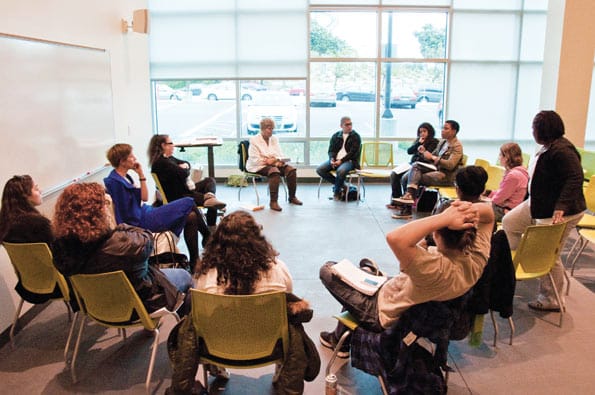
The discussion, conducted in an intimate circle, included four formerly-incarcerated women and about 20 students and members of the community, mostly women. Instructor Jennifer Worley was among the attendees. Students from her Incarceration in America class made up half of the audience.
Pearl Contreras gave the opening speech. She was formerly imprisoned herself and said that she is not proud of that. “What I am proud of is that I came out and I made a change in my life,” she said.
She emphasized the importance of education saying, “Without me getting an education there is no way in the world that I would have made it. The mind is a bad thing to waste.”
As Contreras introduced her friend, the formerly-incarcerated Way-Pass program founder Mary Van Der Horst, she expressed her love and appreciation for her for what she had done to support other formerly-incarcerated women. Contreras gave her a heartfelt hug as Van Der Horst took the floor. Members of the audience teared up as they too shared Contreras’ affection for Van Der Horst.
As Van Der Horst facilitated a discussion on the history of women and incarceration in California and the history of the Way-Pass program, the discussion quickly shifted toward a forum for listening to and sharing stories with previously-incarcerated women as they spoke about the experience of leaving prison and struggling to integrate back into a changed world.
Way-Pass member Sandra Johnson explained that when she left prison, the only support she was given was $200, which she then had to use for her bus ride out of prison and to buy clothes.
“Coming out of prison is hard,” she said. “Especially when you don’t have anybody. That is why I want to help other women. Woman is strength.”
Johnson was laid off of work for having a criminal record and said that it was a challenge to go back to school. She said she felt anxious and scared and did not feel confident. The Way-Pass program has helped her stay in school.
When Way-Pass was originally founded it was meant to provide women with school supplies and even things like diapers. By covering basic necessities, the program hoped to help members succeed in school. Van Der Horst wants to extend the Way-Pass program from what it is now, a college support program, to a program for housing and business-creating.
“We want to make our community strong and create a sustainable community where we sustain each other,” she said.