Wendy Kaufmyn: a City College instructor and an activist for non-violence
“Non-violence is the only way to get sustainable change,” Kaufmyn said. “If you use violence you might win, but you aren’t changing the paradigm.”
By Greg Zeman
Staff Writer
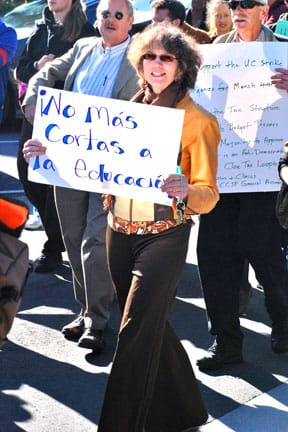
City College engineering instructor Wendy Kaufmyn is a voice for non-violence.
“Non-violence is the only way to get sustainable change,” Kaufmyn said. “If you use violence you might win, but you aren’t changing the paradigm.”
While Kaufmyn has been active in many causes, all of her activism was motivated by her beliefs about non-violence. Kaufmyn was born Jewish, but she does not see Judaism as her religion. “If someone asks what my religion is, I say non-violence,” she said.
Kaufmyn’s activism began years ago when she first arrived at City College in 1983 and attended an on-campus meeting of a then newly-founded group called Witness for Peace. WFP was opposed to president Ronald Reagan’s financial support of the Contras in Nicaragua.
“I went down to Nicaragua with Witness for Peace in opposition to our government’s policy of supporting the Contras,” Kaufmyn said. “We were accompanying villagers there so they wouldn’t be attacked by the Contras because they were funded by the U.S., and it would be very embarrassing if you had U.S. citizens being killed.”
Her experience with WFP shaped the philosophy and strategies she would later bring to the cause of Palestinian solidarity.
“The very first semester I was here, I started getting involved in Central American solidarity,” Kaufmyn said. “It was all about leveraging your privilege. I am privileged and I do have privilege on a lot of levels by just being white and middle class.”
In her work for WFP, Kaufmyn became involved in the cause of anti-nuclear proliferation. One particular group she worked with was the Nevada Desert Experience.
“The Palestinian issue came up, and I really felt more passionate about it than any other issues I had worked on,” she said. “I think a lot of it is because of my Jewish background.” Kaufmyn struggles with the meaning of that background even as she uses it as leverage in her efforts to aid in the liberation of Palestine.
“The idea of using my privilege as a Jew to go there and work for Palestine makes sense,” she said. “The Israeli soldiers that I meet are like my cousins or brothers. So many of them just remind me of people in my family, and I talk to them so comfortably. They do care about my opinion in a way that they’re not going to care about the opinion of the Palestinian whose house I’m standing in front of.”
Kaufmyn says she feels like she has to be careful not to give the wrong impression to the people she is trying to help. “You can’t be sitting there laughing and joking with the soldiers and then have the Palestinians in the village trust you, so I have to be kind of careful on that level,” she said.
Kaufmyn says she feels a strong connection to Palestine and is dedicated to seeing it become “one democratic state for all of its citizens.” She feels like the idea of a Jewish state is discriminatory.
“It is racist to just have Israel be for Jews, and there’s no other country in the world like that,” Kaufmyn said, adding that she saw strong parallels between Israel’s treatment of the Palestinians and that of American Indians by the U.S. government. “It’s Western European colonizers eradicating an indigenous population,” she said.
On her first trip to Palestine, Kaufmyn met several other activists from California. “We met in Palestine, but we’re all from the Bay Area.” Then she met Deeb Kamal, a Palestinian man who had an idea for the children of the village Deir Ibzi’a, and once again she had the opportunity to leverage her privilege in the service of her cause.
“Deeb looked around and saw that the children were depressed and organized a summer camp,” Kaufmyn said. “He asked ISM for some internationals to use as protection. It ended up being six of us from the Bay Area at this summer camp.”
Kaufmyn said Kamal was a huge influence on the group of Bay Area activists.
“He was really inspiring,” she said. “He told us, ‘These demonstrations you’re doing, this is not the way to fight for the future of Palestine.’ He basically encouraged us to start a group to raise money for scholarships.”
That’s exactly what they did. “We started that summer in 2002,” Kaufmyn said. “In some ways it’s not political at all. We’re raising money for scholarships for people that are under hard economic conditions.”
One of the main sources of funding for the scholarships, outside of donations, is the Friends of Deir Ibzi’a project, which purchases embroidery from Palestinian women and sells them in the states.
“We give them a better price than they get in Ramalla, and we use them to fund the scholarships and as an educational tool,” Kaufmyn said.
She says she is done seeking out new causes to fight. “Either Palestine will become free or I will retire as an activist, whatever comes first,” Kaufmyn said. “But I don’t see myself moving on to a different cause after that.”
“They are a group that protests the Nevada test site,” she said. “The idea is that if we can stop the testing of these weapons, that ends the first stage of their production.”
It is that realm of engineering, defense research and development that Kaufmyn says once gave her pause about her career as an engineering professor.
“That was actually part of the conflict I felt for many years, and I still feel it, but it doesn’t bother me as much anymore,” Kaufmyn said. “I figure it’s a student’s choice to do what they will with the education that they get. I talk about what it can be used for and I don’t hide my political views.”
Kaufmyn’s activism has also touched on an issue deeply woven into the social fabric of the Bay Area — homelessness.
“Back in the early nineties there was a mayor called Frank Jordan and he had something that he instituted called the Matrix Program and it was very anti-homeless,” she said. “Aspects of daily living, like sleeping, were made illegal and the police gave thousands of tickets. An organization started in response to this program to show that this wasn’t the humane or even practical way to treat homelessness.”
Kaufmyn said that while she made a positive impact in all of the groups she was involved with, she didn’t come into her own as an activist until she found the cause of Palestinian solidarity.
“I would say I was an activist du jour. I would basically jump on the bandwagon of issues people were dealing with,” she said. “That’s how I got involved with the Central American project, nuclear issues and then homelessness. I wasn’t really a leader, I would just follow.”
But when Kaufmyn became aware of the Israeli-Palestinian conflict, her activism took a more concentrated approach. She began traveling to the West Bank in 2002 and she has been back many times since.
She is an active member of the International Solidarity Movement, a Palestinian-led international organization opposed to what it sees as Israeli occupation of Palestinian land.