A Close Look at Accusations of Chancellor Misconduct
Vacation balances misplaced and an increase in stipend money among the allegations levied against chancellor.

By Karla Lopes, Bryné Hadnott, Kalyxa Roman and Tom Whitehead
It’s been over a month since City College of San Francisco Chancellor Kimberlee Messina was placed on paid administrative leave following allegations of financial misconduct.
The scandal, which was made public in a Sept. 30 San Francisco Chronicle exposé, revealed that Messina’s executive assistant, Mary Grace Esteban, alerted Board of Trustees President Aliya Chisti to multiple allegations involving unapproved stipends, vacation days, and inappropriate use of college funds.
Esteban, who declined an interview request from The Guardsman, has been at the college since 2014 and has worked under 11 chancellors. This is the first time she has ever made allegations against a chancellor.
According to a Sept. 11 letter obtained by the Chronicle from Chisti to Esteban, Esteban’s allegations include:
- A monthly stipend Messina received without board approval.
- ‘Salary in excess of the salary was approved by the Board.’
- Vacation days taken without adjusting her vacation balance.
- Travel requests that were not approved by the Board but instead ‘signed by the vice chancellor of finance, a direct report.’
- Payments made to the former interim vice chancellor of finance that ‘may have been improperly characterized as contractor payments.’
- Instructions to Esteban to track attendance and work hours for the chancellor’s office, ‘even though this approach was never previously taken and is not taken in other divisions.’
- Instructions to Esteban to pay for a group lunch for staff with a City College credit card. After human resources told Esteban ‘not to use your card for such charges … the stated purpose of the lunch meeting in its original calendar invitation was later changed.’
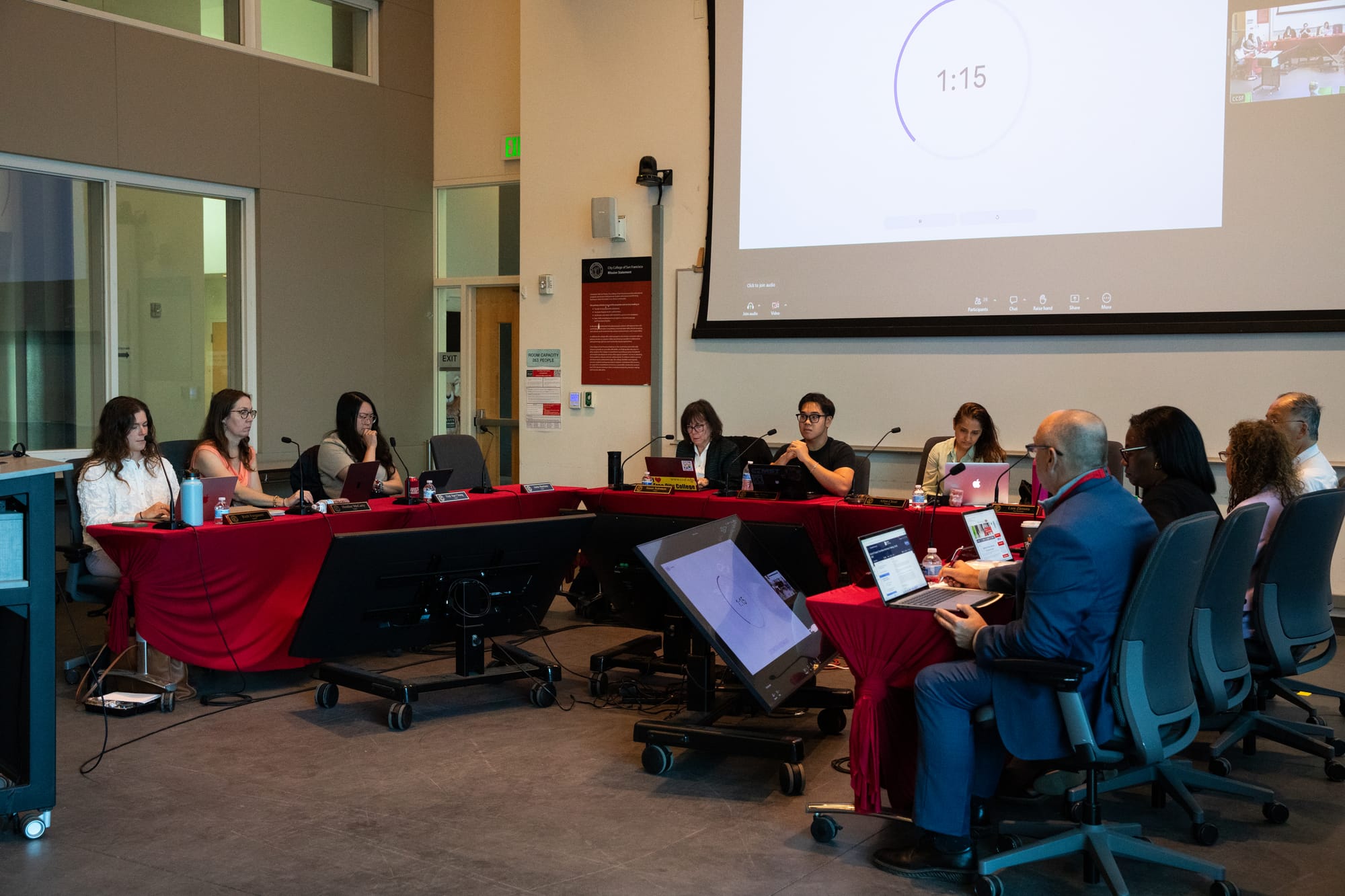
The board of trustees held a special meeting on Oct. 5 and placed Messina on administrative leave. On Oct. 8, the board approved a contract with Oppenheimer Investigative Group LLP to carry out an investigation.
Messina, when contacted by The Guardsman via email, wrote “I am not at liberty to discuss the matter at this time.”
The Guardsman has been investigating the allegations. Here are our findings.
Unapproved Stipends
The Guardsman obtained an email written by Vice Chancellor of Finance and Administrative Affairs Yulian Ligioso to Messina on Aug. 15, 2025. It states that Ligioso presented an analysis about chancellor stipends to the board of trustees during a closed session of a board meeting the night before.
Ligioso’s analysis showed that vice chancellors and associate vice chancellors had received expense stipends of $900 and $500 per month, respectively, since at least 2015. The Guardsman contacted Ligioso multiple times for comment and received no response as of press time.
“The vice chancellor and associate vice chancellor stipends were not noted in our respective contracts, but rather attached to the position,” Ligioso wrote. In other words, the stipends were paid to these positions, but not explicitly included in the respective employment agreements, amounting to a commonly accepted practice if not a publicly acknowledged one.
In his email, Ligioso recommended Messina receive an expense stipend in the amount of $1,620 per month, a number calculated through napkin math.
“The incremental increase [in the monthly stipend amount] from associate vice chancellor to vice chancellor is $400 per month or 80%,” he wrote. “Extrapolating the same increase from vice chancellor to chancellor calculates to $1,620 per month.”
In addition to receiving a $350,000 salary, Messina’s contract provides for a total of $25,000 in relocation expenses and a $60 per month stipend for a telephone.
The contract does not identify any other annual stipends but does provide for a “yearly optional fringe benefit dollar allowance [that] shall be the same as that which is provided by the Board for the District's twelve-month management employees.” It does not specify what this amount is.
According to the college’s human resources department, fringe benefits are an extension of health benefits, including dental and life insurance.
City College’s previous chancellor, Mitch Bailey, only appeared to have one stipend in his contract: $60 per month for a personal communication device. According to knowledgeable sources, no chancellors prior to Messina have received regular expense stipends.
At the time of the Aug. 14 meeting where Ligioso presented his analysis, the board president, Anita Martinez, did not announce any reportable actions from the closed session, a recording of the meeting shows. In his email to Messina, Ligioso stated that Martinez “[directed] me to implement the chancellor’s monthly expense stipend” during the session.
Ligioso then looped payroll administrator Maria D’Souza into the email thread, directing her to add the $1,620 per month expense stipend to Messina’s compensation, referring to the thread and his account of the closed meeting discussion of the stipends as “audit backup.” It is unclear if any trustees were notified of the final stipend amount.
A spreadsheet of administrator payroll from the 2025-26 fiscal year shows Messina received $346,023 in salary — lower than the amount listed in her contract. But with the monthly stipend amount of $1,620, Messina’s pay would have added up to $369,440.
On Oct. 22, 2026, the Board officially ratified and approved a $500 stipend for associate vice chancellors and a $900 stipend for vice chancellors. But the question of official Board approval of the chancellor’s expense stipend was left unresolved.
The proposal to approve these stipends also stated that “administrators shall not receive any other stipend/allowance except as may be included in their employment agreement approved by the Governing Board in open session.”
“The reason [the proposal] was brought forth is to make sure no stipends are being paid that have not been Board-approved,” said Shannon Carter, the current vice chancellor of finance and administrative affairs, during the meeting.
The Board’s action does not alter Messina’s stipend nor does it include a stipend amount for chancellors.
The Guardsman reached out to former Board of Trustees President Anita Martinez for comment on her recollection of the discussion of the chancellor’s stipend. She declined to comment. Vice Chancellor Shannon Carter and Maria D’Souza of the payroll department also declined to comment.
Vacation Balance
The allegation about Messina’s vacation balance stated that it "appears to remain at 25 days despite vacation she took in August and October, 2025."
The chancellor’s contract specifies that she would receive 21.5 days of vacation per fiscal year, exclusive of holidays, which means she would be entitled to 26.87 vacation days for the period between July 1, 2025 and October 2026. There were 26 paid holidays and flex days in this same period, for a total of 52.87 days. Messina also receives 10 additional professional development days of leave per year.
The contract specifies that earned vacation may be carried over to the next fiscal year, provided that the accumulated balance may not exceed 45 days. All vacation time must be scheduled in advance and approved by the board president.
The number of vacation and holiday days the board of trustees authorized for the chancellor between her date of hire and October 2026 is not made public in the agenda or minutes of meetings of the Board of Trustees, since this is discussed in closed session.
The Guardsman requested the chancellor’s calendar from the date of hire and pay records for FY 2025-26 and FY 2026-27 but has not received either of them as of press time.
Vice Chancellor Allowance Payments
The Guardsman was able to confirm that Ligioso was paid as a vendor for housing expenses while employed at the college. According to staff with access to the payment records in the college’s purchasing department, Ligioso received payments to reimburse him for housing expenses beginning shortly after he was hired, in the fall semester at the start of FY 2024-25.
A memorandum written by former Chancellor Mitch Bailey on April 24, 2025, approved reimbursements for a residential lease in San Diego beginning on May 1, 2025. But reimbursement payments for the lease began before this memorandum was written.
The payments continued after Messina was hired in July 2025, until Ligioso’s two-year assignment was completed in July 2026. Reimbursing permanent housing costs in the form of vendor payments is allowed under very limited circumstances, which do not appear to have been met in this case. Such payments can trigger tax audits to investigate payroll or income tax avoidance. Ligioso, who was a licensed CPA until his license expired in May 2022, would likely have been aware of the tax laws governing such payments.
The Guardsman contacted Ligioso to request comment on the issue, but has not received a response at press time.
Chancellor’s Office Abnormalities
Esteban topped off her allegations with two flags about office culture, including that Messina ordered her to track office staff’s work hours on a spreadsheet and use a college credit card to pay for a staff lunch, despite the credit card being for travel purposes only.
The hour tracking is not a norm in other departments and had never been done in the chancellor’s office, according to Esteban's allegations.
Investigation Ongoing
The college's investigation is still underway. The Guardsman contacted Messina for a response and in an email sent on Nov. 4, Messina stated that she has not been contacted by the investigator to share her response to the allegations.
“I had been informed that this would be a prompt and confidential investigation, so I am hopeful that I will be interviewed soon,” Messina wrote.
So far, students don’t seem to be affected. Associated student council senators interviewed before a meeting of the general council on Wednesday described the impact as “meh.” Senator Gauri Sauthosh, who is also a student worker, spoke for her colleagues when she noted that Chancellor Messina hasn’t had much contact with the student council. She said that she hasn’t seen any signs of disruption in student life since the chancellor went on administrative leave.
Ocean Campus President Neche Okeke mirrored the sentiment, deferring to members of the executive council who have more contact with administrators.
Lab aide Hamiya Jones in the Queer Resource Center who has been outspoken about the Chancellor’s efforts to prevent student workers from organizing over longer hours and higher wages, and about earlier cuts to the lab aide budget, also said that there have been no noticeable effects on the functioning of the resource center.
The same may not be true of faculty members, particularly those active in participatory governance committees.
College Affected
The Guardsman approached some City College's faculty members for comments. Academic Senate President Katia Fuchs believes that the investigations need to happen as expediently and as transparently as possible. “I don't know how long it will take. I have nothing but to hope that the investigation is thorough, and that the results are made available,” Fuchs said.
Although not able to predict any results from the investigations right now, faculty union President Robin Pugh also believes that the investigations must be done in a transparent way, and that the City College body needs to make sure that whoever is leading the investigation must not have conflicts of interest. “It does seem like the Board has met that,” Pugh highlighted.
“The best we can do is to keep on going, but it's difficult, anytime we have this kind of upset in our leadership, it's steps back when we should be making steps forward,” Fuchs added. Fuchs hopes to work and support acting Chancellor David Yee during this time, and after the investigation is concluded, she hopes that “we come together as a college community and support whatever leadership is in place.”