Activists commemorate the invasion of Gaza City
Over 350 activists packed the Burlingame Recreation Center Feb. 6 to commemorate Operation Cast Lead, an Israeli Defense Force airstrike and invasion of Gaza City — called the Gaza Massacre by the Palestinian people and their supporters.
By Greg ZemanThe Guardsman
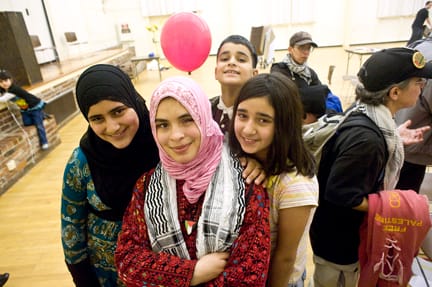
Over 350 activists packed the Burlingame Recreation Center Feb. 6 to commemorate Operation Cast Lead, an Israeli Defense Force airstrike and invasion of Gaza City — called the Gaza Massacre by the Palestinian people and their supporters.
Roughly 1,400 Palestinians and 13 Israelis were killed during the battle between IDF and Hamass forces, which lasted from Dec. 27, 2008 to Jan. 18, 2009.
The main speaker for the event was Professor Haidar Eid, who teaches English literature at Al-Aqsa University in Gaza City. He urged people in the Bay Area to seek out their own information about the plight of the Palestinian people, which he said is often ignored by American main-stream media.
Many non-Palestinian activist groups and individuals participated in the event, including Tony Gonzalez, director of American Indian Movement West, who stressed the importance of solidarity between the Palestinian and Native American peoples.
“The event is to acknowledge the massacre that occurred a year ago and to continue to raise consciousness that the situation has not been resolved at all, at the ground level or at the international political level,” Gonzalez said. “People are suffering and children are being denied quality of life, education and standard of living.”
Sam Ayesh, a 16-year-old Palestinian activist affiliated with Arab Youth, said Israel needs to acknowledge its crimes against the Palestinian people.
“Everybody knows about genocide, and everyone knows that genocide is going on,” Ayesh said. “Israel thinks they can hide everything, all their war crimes and genocide. They’re not hiding their genocide and everyone sees.”
“I have a Palestinian ID because when I was born my mom took me back there,” said Lina Ereikat, 18, a City College student studying political science. She wants to see an end to Jewish settlements in the West Bank and Gaza Strip.
“These settlements are being built and people’s houses are being torn down so people who are not even from Israel can go and live there for free and they get everything paid for. But us who were native to that land, we’re not even allowed to go. If I want to, I can’t even go back home,” she said. “Everyday sources that the Palestinians need are being taken away.”
Ziad Abbas, an activist working with the Middle East Children’s Alliance, said that the event had many goals but that above all it was a show of solidarity with the Palestinian people and “to send a message to the people in Palestine and in Gaza that people outside are standing with them, backing their struggle.”
“Different kinds of organizations are coming together in solidarity around what’s going on in Palestine,” he said.
Ereikat said the hardships faced by the Palestinians are hindering the ability of the youth to get access to education and other basic resources.
“Because of checkpoints, most of the kids can’t go to school. They can’t go get food. A lot of people can’t go to work because of checkpoints,” she said. “Innocent civilians are getting killed everyday and they’re just trying to live.”
The issue of security checkpoints is one that resonates with many Palestinian activists as a matter of basic dignity.
“Tear down the check points; tear down the wall; let people get from point A to point B,” Ayesh said. “When you go from Ramallah to the Dome of the Rock, it’s about 30 to 45 minutes, but when you go through the checkpoints, it takes hours or more.”
Ayesh can envision only one solution to the conflict — a two state solution.
“Two states: Israel gets a part of it and Palestine gets a part,” he said.