Architect sees potential for wind power; Green energy could come to campus
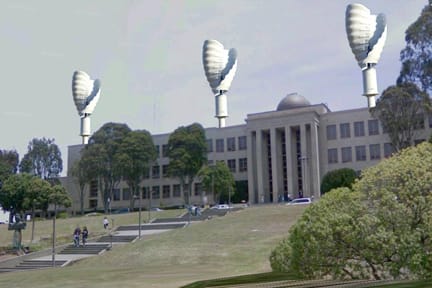
During a visit to City College’s Ocean campus, local architect Bob Boles felt the wind blowing up Phelan Steps and over Science Hall, which led him to envision a more beautiful and sustainable future for City College.
By Brant Ozanich
The Guardsman
During a visit to City College’s Ocean campus, local architect Bob Boles felt the wind blowing up Phelan Steps and over Science Hall, which led him to envision a more beautiful and sustainable future for City College.
Boles then wrote a fictional news story that explored the possibility of wind turbines being constructed atop Science Hall to provide the college with, what he claimed, would be more than enough energy to power the campus. His ideas raised new questions about sustainable energy practices City College.
“The future is what you’re gonna be living in. My generation and the previous generations have messed it up for you, but you may be the ones to have to figure out how to fix things,” Boles said. “It’s very real, it’s gonna happen, you’re gonna live in it.”
Administration interested
Trustee John Rizzo said the idea for wind power has been floating around for a while and he personally tried to get a wind turbine for the school through the city’s wind task force.
“There’s a number of people at City College that are enthusiastic about it. It could be a great teaching tool,” Rizzo said. “There hasn’t been any funding for it recently, except for the Chinatown campus, which has some solar panels in its design.”
According to the college’s sustainability plan, published in 2009, all current and future building projects should be assessed for solar and wind potential to reduce the environmental impact associated with fossil fuels. Boles’ dream of a wind farm at City College is actually not that far-fetched.
Still, the idea of solar panels lining the roof of City College’s buildings is more plausible. While wind energy can be more effective in places like the Central Valley or the Midwest, the Bay Area is more likely to see better results from solar power, Ben Macri, chairman of the automotive technology department at City College, said.
“Solar power is more generally useful and the price of panels has gone down in the last year. I think wind power is more effective in certain locations,” Boles said. “Whether one system or the other makes more sense is really a matter of engineering.”
Teaching sustainability
City College currently offers a course on solar power installation, CNST 101, at the Evans campus and Macri hopes the school will add an advanced installation course soon.
The engineering and biology departments at City College are also working together to implement a multi-disciplinary certificate program that offers sustainable business and design practices to students and professionals and could possibly become a new sustainability major.
“I have a feeling that this may go way beyond just a few courses and a certificate. This may be the way of the future,” Fariborz Saniee, chair of the engineering department at City College, said.
Boles, a Cal Poly San Luis Obispo graduate has been interested in sustainability and alternative energy for a long time.
Once he graduated, Boles worked at and lived in a community in Davis, Calif., that used only solar energy and focused on sustainable farming and alternative transportation. It was the first of it’s kind in the country.
The photovoltaic system he has on the roof of his house has decreased his energy bill by about 75 percent and Boles believes that if the price of solar panels were to drop by half, nearly every home in the city would install them.
“Maybe this is a dream, but I think it’s worth pursuing,” he said. “Every single person can make a difference in how they live their lives and how they help heal the planet.”