Chinese art teaches history at YBCA
Yerba Buena Center for the Arts features two exhibits about China – a documentary series and art installations by Song Dong – that pull back the jade curtain to reveal current Chinese issues and heal wounds from China’s past.
By Catherine Lee
The Guardsman
Yerba Buena Center for the Arts features two exhibits about China – a documentary series and art installations by Song Dong – that pull back the jade curtain to reveal current Chinese issues and heal wounds from China’s past.
The raw truths exposed in the documentary film series will engage and outrage viewers by revealing the injustices of China’s modern society.
A six-part series of underground documentary films promises to give audiences a new view of China, while the galleries host Song Dong’s conceptual art that attempts to heal the scars of China’s 1960s Cultural Revolution.
“You find in Song Dong’s art a healing message from an illness caused by culture or society,” University of Chicago Art History Professor Wu Hung said during an artist’s round table discussion.
Wounds are still present from the Cultural Revolution, a government-sponsored series of social-engineering programs imposed from 1966 to 1971 by then Chairman Mao Zedong.
In an effort to cleanse society of class structure and capitalists, Mao threw many educated, professional and urban Chinese into “re-education camps,” where they were forced to purge their elitist thoughts and adopt a proletarian worldview.
Re-education commonly included torture and extreme acts of degradation. Participants were compelled to turn in their friends, family and colleagues for being insufficiently communist.
Hundreds of thousands were killed, and many more people committed suicide to escape, but to this day, no official tally of the dead has been released.
“A lot of art starting in the 80s was about family, because there had been severe damage in families during the Cultural Revolution,” Wu said.
“Song’s father was sent away in 1966, at the beginning of the Cultural Revolution, soon after Song was born,” said Zheng Shengtian, the editor of “Yishu”, the first English language journal devoted to Chinese art and culture.
Song’s video installations use video to “touch” people, emotionally, Zheng said. In “Touching My Father” the son’s hand reaches for the image of his seated father via a projection, representing an absence of physical connection in childhood.
After his father died, Song determined a method of using art to help his mother recover.
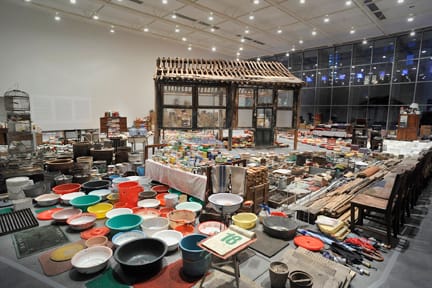
Song’s mother collected and stored everything she ever obtained. Their Beijing home bulged with hoarded items. Song transmuted this hoard into an art installation, a manifestation of the adage “Waste Not,” also the name of the exhibit.
The collected objects also signify family life together, a physical account of sentimental feelings.
To release the emotions stored in the household objects, Song and his mother sorted and arranged over 10,000 collected pieces – toothpaste tubes, shoes, combs, crayons and bric-a-brac – that carpet the YBCA main gallery.
The objects are arranged in sets, and the resonance of color and shape is oddly poetic. The room is crammed full, yet orderly.
Zheng, Wu and Song said patrons reacting strongly, some crying, after seeing the installation. For some people, this lifetime of hoarding or saving evokes painful memories of the Great Depression, the Korean War and other deprived eras, Zheng said.
“In the 1960s, during the Cultural Revolution, everything was paid for with coupons. There was one year when fabric rations were just two feet of cloth. These were very hard times for a mother to try and take care of her family under these conditions. This poverty caused mothers so much pain because they couldn’t clothe their children with their meager cloth rations,” Zheng said.
His mother’s lifelong fear of deprivation and shortages was the artistic medium through which this 50-year time capsule was created. The objects transmit her trauma accumulated over decades.
“People who haven’t experienced, directly, this level of poverty may have a hard time understanding the material hoarding they see in ‘Waste Not’,” Zheng said.
The narrative is essential to this installation.
“Otherwise it just looks like a flea market, or a bunch of junk,” Dong said.
The YBCA film series “Fearless: Chinese Independent Documentaries,” accompanies Song’s exhibit, giving a more direct look at the society’s sufferers.
“For about five years, Chinese filmmakers have produced something like a new wave in cinema where most of the documentaries are political in nature, with relatively small budgets, made on cheap but powerful equipment,” YBCA Film and Video Curator Joel Shepard said.
Chinese state-controlled media defines films as either “official” or “unofficial.” Unauthorized films made and distributed beyond the censorship apparatus are illegal.
Unlike in western cinema, the terms “underground” and “independent” are profoundly meaningful and potentially dangerous descriptors for Chinese artists.
“Independent” filmmakers have been fined, imprisoned and temporarily banned from filmmaking in some instances.
Nobody has done a documentary series like “Fearless” yet, Shepard said.
San Francisco is fortunate enough to present this series in large part because of the New York-based company dGenerate Films, Shepard said. The company specializes in distributing “uncensored Chinese media from deep within mainland China’s independent, and underground, film scene,” dGenerate’s website said.
All films have a student discount rate at the door and are in Mandarin with English subtitles.
Email:
clee@theguardsman.com