City College instructor runs for mayor of San Francisco
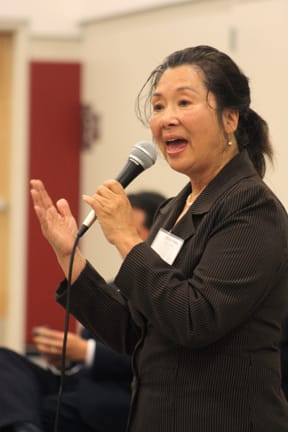
After placing fourth in the 2007 San Francisco mayoral race, City College music instructor Wilma Pang says she is “sitting pretty” to win this November with the help of a new voting process called ranked-choice voting.
By Elliot Owen
The Guardsman
After placing fourth in the 2007 San Francisco mayoral race, City College music instructor Wilma Pang says she is “sitting pretty” to win this November with the help of a new voting process called ranked-choice voting.
“This year it’s a very different ballgame,” she said. “Even the experts cannot predict who is going to be the mayor.”
Also known as instant-runoff voting, ranked-choice voting allows voters to pick their top three choices. If no candidate earns the majority of votes, the last-place candidate is eliminated and all ballots where that candidate was chosen as second or third, are redistributed until someone earns the majority.
Ranked-choice voting has never been used in a San Francisco mayoral election before.
Her position as an Asian-American woman mirrors Oakland Mayor Jean Quan, who unexpectedly beat Don Perata in 2010 under the new voting system.
“It’s all about building relationships and grassroots networking,” Quan said about her victory. “I was able to win in Oakland because I knocked on doors and asked everyone to take another look at me.”
As the founder and co-chair of A Better Chinatown Tomorrow, a non-profit that funds music- and art-related events to promote and honor Chinatown’s culture, Pang is no stranger to community work and grassroots organizing.
Howard Wong, co-chairman of ABCT, thinks Pang’s experience as a teacher and ethnic community member makes her appealing to voters.
“She doesn’t have as much of a political stake as other candidates, which would allow her to speak more honestly,” Wong said.
Pang’s first encounter with politics was in 2006 when Chinatown community members suggested she run for San Francisco School Board. She received 32,235 – 6.9 percent – of all votes. Encouraged by voter support, Pang ran in the 2007 mayoral election against Gavin Newsom.
“Nobody dared to run against Newsom,” she said. “It was a surprise because I actually came in distant second to Newsom in many of the districts because of the Asian population.”
She won 7,274 votes – 5.07 percent – placing fourth overall.
Since that election, her political platform remains largely unchanged.
“Everyone is talking about the budget deficit and the government shutdown and nobody is thinking about women’s issues,” she says. “Women make up over 50 percent of the population and nobody is thinking about childcare or our voice in city government.”
Another top concern of Pang’s is job security. She argues that her position as a woman would enable her to create a more effective dialogue between San Franciscans and City Hall to discuss jobs within the city.
“[Women] do a better job at negotiating, we [plan ahead] better, we are in a better position to listen,” she said.
Pang believes teachers and parents are fleeing the city because they can’t afford housing, and high school graduates are hesitating to pay high tuition at the community college level.
She wants to address how rising tuition and housing costs are affecting public education. “We’re losing kids by the minute,” she said.
In addition, Pang stresses the need for more affordable city-wide childcare options for mothers who work and/or attend school – an issue Pang, a mother herself, knows from experience.
“I went to school after I had three children, childcare really helped me. But its even harder nowadays,” she said.
San Francisco’s projected budget deficit for the 2011 - 2012 fiscal year is expected to soar to $306 million. Projections for the following years are even higher. If elected mayor, Pang intends to take a closer look at expensive projects that would add to the deficit.
“The central subway to Chinatown costs $1.58 billion,” she said. “We have to look at what’s priority and the central subway shouldn’t be a priority. That money could go somewhere else.”
Pang has intermittently taught in the City College music department 1976 and believes that her experience as a musician and educator enables her to approach issues from a different angle.
“We have to find creative ways to generate money. And I will do that,” she said.
Email:
email@theguardsman.com