Freedom through Facebook
Political activists and organizers are discovering social media platforms like Facebook and Twitter have potential far beyond recording the minutia of a person’s life in 140 characters or less.
By Tony LeTigre
The Guardsman
Political activists and organizers are discovering social media platforms like Facebook and Twitter have potential far beyond recording the minutia of a person’s life in 140 characters or less.
Kenya Lewis of KUSF recognized the major role that Facebook played in the radio station’s Feb. 1 protest at San Francisco City Hall.
“Facebook is the primary tool we’ve used to get organized,” Lewis said. “In a one-month period between January and February we have over 1.3 million page views and more than 7,200 friends on the Save KUSF page. Facebook has been our primary avenue to raise money for FCC lawyers and just let people know what’s what.”
Frank Lara of the Act Now to End War and Stop Racism Coalition attended recent pro-Egyptian-democracy rallies in San Francisco.
“Facebook is becoming an organizing tool for our critical work now that the youth are becoming more involved,” Lara said.
But Lara doesn’t think online social networking has been utilized to its full potential yet.
“It will be great when we in the U.S. start to use social networking tools properly,” he said.
Politicians at varying levels have also included these networking tools in their repertoires to spread their messages. Laura Wells, an Oakland resident, became aware of social media last year while running as a gubernatorial candidate for the Green Party.
“A Facebook page for an event gives it some validity,” she said. “I like to see how many people are in the group or attending the event. If a Facebook event had like two people for a political demo, then I might take pause.”
Miles Bainbridge, a computer science major at City College who volunteered for progressive candidate Rafael Mandelman’s campaign for San Francisco Supervisor last year, said that early on, the Mandelman campaign brought in a social media consultant to help them strategize.
“We had several thousand people on our Facebook page and used it to organize volunteers as well as to let supporters know where events were going to take place,” Bainbridge said. “In the past it was word of mouth, calling people one at a time. Social media platforms are a way more efficient way of organizing, since you can send one message and reach everyone at once.”
Mandelman’s consultant, Eric Harr, an award-winning CBS anchor and founder and CEO of Resonate Social Media, is one of many canny entrepreneurs who have adapted their skills to jump through the window of opportunity afforded by technological advances.
“People have been waiting for this for thousands of years,” Harr said. “First the church controlled the message, then the printing press controlled it, now the people control their own message, for the first time, in an unprecedented way.”
Still, not everyone has embraced social media, and the generation gap is often evident. Steve Kessler, a Berkeley resident and Berkeley Labor Commission member who is in his early 60s, heard about the pro-Egyptian democracy rallies from the KPFA community radio coverage of events.
“I’m a troglodyte. I don’t use or follow Facebook or Twitter,” Kessler said. “I should learn them but I’m concerned about privacy, especially on Facebook.” Michelle Schudel, a San Francisco resident and activist who attended the Feb. 11 pro-Egyptian rally in the Civic Center, still uses phone calls, emails and text messages to organize and promote events, in addition to Facebook and other online networking portals.
“I announce events by posting them as status updates on my Facebook page, or with bigger events, by creating a page for the event and inviting my Facebook friends,” Schudel said. “Most of my Facebook friends will ‘like’ an event, but very few will actually attend. So when I really want to motivate people to attend, I call or make personal contact with people individually.”
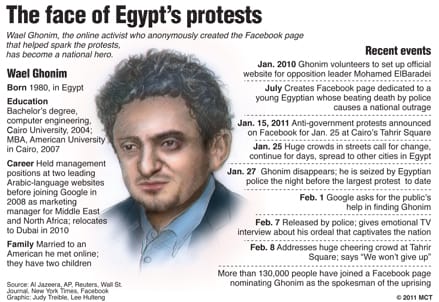
Harr said the recent uprising in Egypt prevailed despite the Mubarak regime disrupted Internet access in an attempt to prevent organizing via social media, but to no avail.
“What you saw was the Egyptian government completely underestimating the power of the people to use social media tools to organize,” Harr said. “How can you really stop people from communicating? If you shut Facebook down, there’s Twitter. Shut Twitter down and there’s YouTube. It’s like trying to hold back a tsunami with your hand.”
Catherine Lee contributed to this report.