From Classroom to Cutting Edge: BEMA Group Experiences the Future of Media at Silicon Valley Video Summit
City College students attended the Silicon Valley Video Summit to explore how cloud production, advanced lighting, and generative AI are reshaping the future of media creation.
By Qi Mai
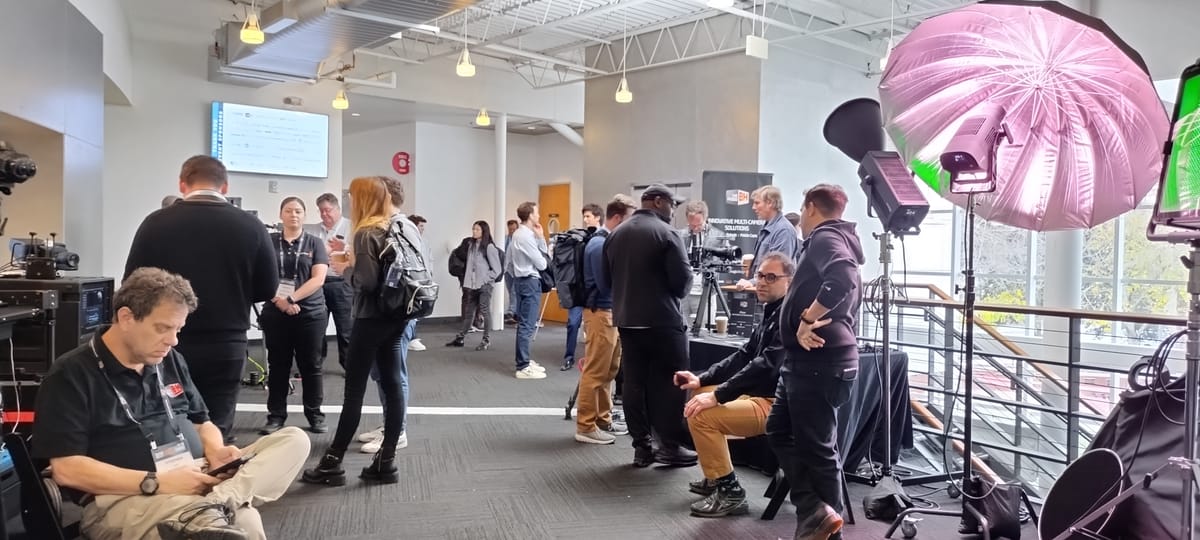
On Jan. 27, BEMA Department Chair and Professor Malcolm Cecil, Professor Misha Antonich, and students attended the Silicon Valley Video Summit held on the 2nd floor at the Computer History Museum in Mountain View. The event brought together about 38 media production and service sponsors, along with SMPTE (Society of Motion Picture and Television Engineers), a global organization that sets technical standards for media, broadcast, and film industries and several event partners. It was an opportunity for students to see how the professional media world is rapidly changing, especially through cloud technology and generative AI.
A major focus of the summit was generative AI. Sessions such as “Navigating the New Wave of Generative AI Tools” and “AI Collective: The Creative Revolution — AI’s Impact on Image, Video, and Audio” explored how AI is transforming creative work. Speakers discussed AI tools that assist with editing, visual effects, sound design, and content generation. What stood out most was the idea that AI is not replacing creators but becoming a creative partner. At the same time, professionals emphasized the importance of ethics, originality, and responsible use.
One company featured at the summit was Advanced Systems Group (ASG). They demonstrated how cloud- and hybrid-media production workflows are transforming the industry. In the past, high-level production required expensive equipment, on-site servers, and large technical teams. Now, with cloud-based systems and AI-powered tools, production has become more flexible and cost-effective. Teams can collaborate remotely, access shared storage instantly, and automate time-consuming tasks. Seeing these tools in action made the students realize how much the industry is shifting toward accessibility and efficiency.
Another company, Profoto, is known for lighting-shaping technology. Their slogan– faster, lighter, brighter– perfectly described their new cinema lighting tools. Their lights and reflectors can produce professional-quality results even from very short distances and with relatively low wattage, yet they are also capable of extremely powerful output when needed. This range gives filmmakers and content creators more flexibility on set. Good lighting has always been essential in visual storytelling, but Profoto’s tools show how innovation can make setups quicker and more adaptable without sacrificing quality.
Attending the summit with professors made the experience even more meaningful. The students were able to connect what they learned in classes with real industry practices. Overall, the event showed them that the future of media production will depend on people who understand both storytelling and technology, and who are ready to adapt as tools continue to evolve. Now, the students are considering how they will learn AI skills.