City College’s historic planetarium welcomed visitors for a guided exploration of the stars.
By Bryné Hadnott
Twenty-one astronomy enthusiasts gathered on Feb.18 in the historical planetarium on the fourth floor of Science Hall for “Apparent Motions,” a guided tour of the stars narrated by former California Academy of Sciences presenter Blue Polansky.
The planetarium is maintained by student volunteers from “Astronomy Outreachers,” a service learning program started by Professor Claia Bryja in 2022. During the semester, students host telescope-viewing nights on the roof and catalog historical log notes on astronomical observations.
“The Navy requisitioned the original telescope in the dome for World War II, wanting to use it for the war effort,” said Bryja.
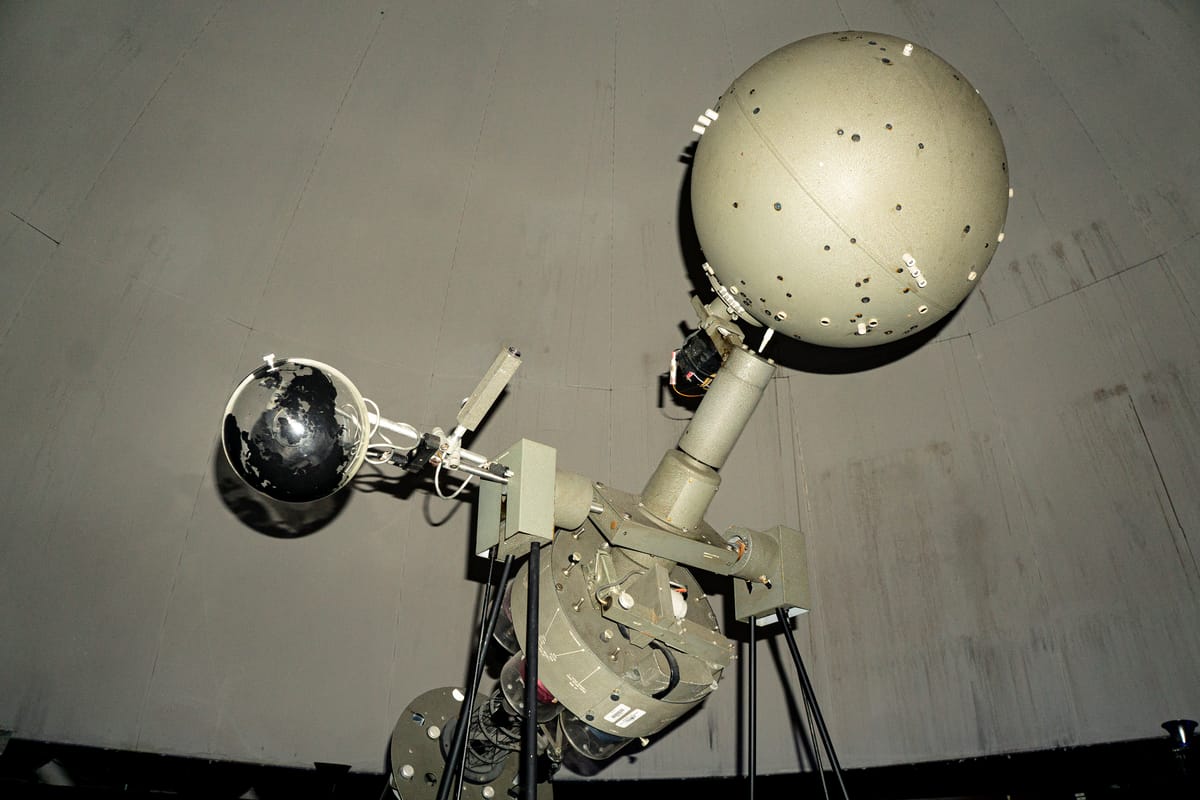
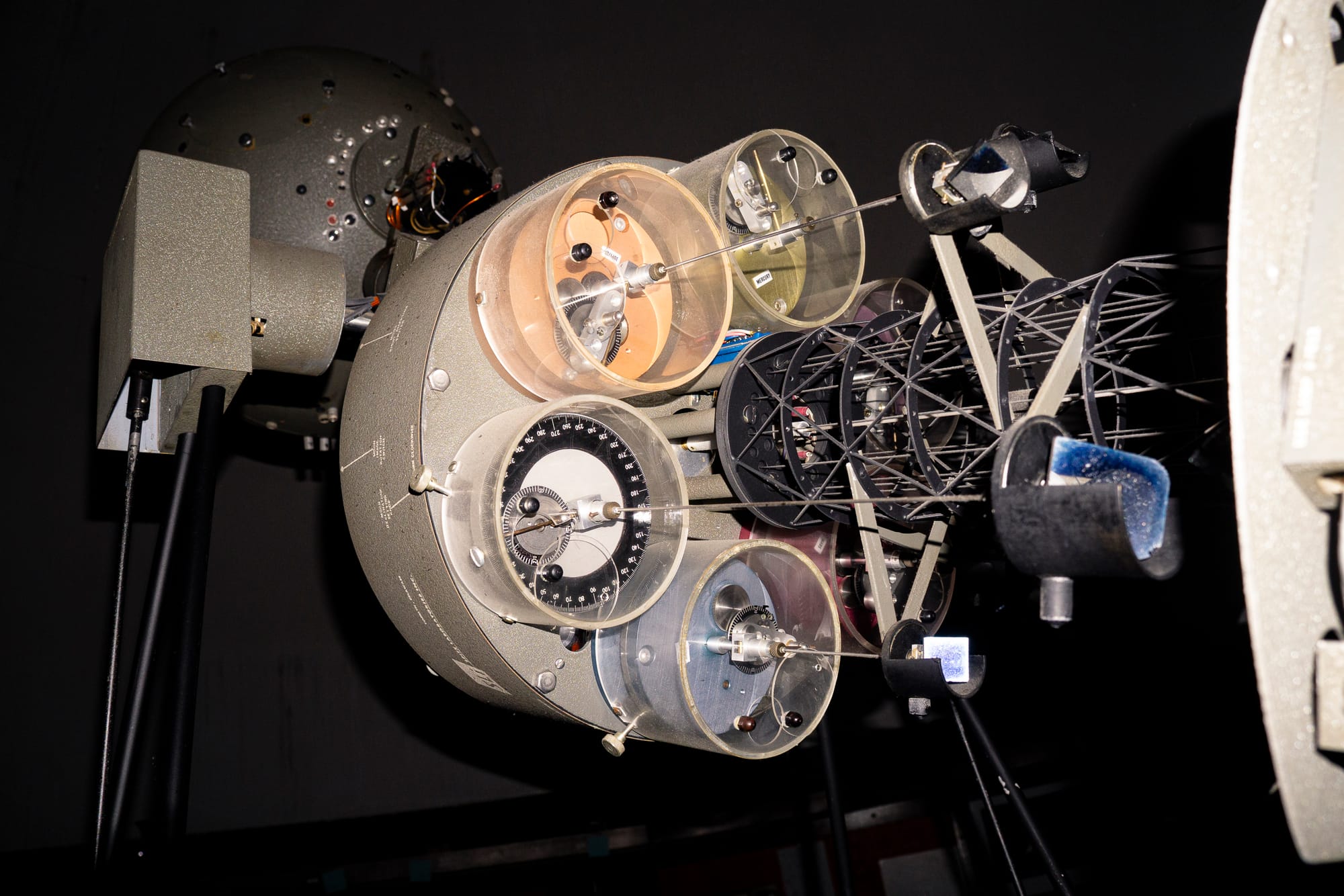
Today, the dome houses a 55-year-old mechanical planetarium projector atop a pillar that descends to the entrance of Science Hall.
“In the 1970s, the astronomy faculty bought a top-of-the-line planetarium projector from Spitz, a company that did planetarium shows,” said Bryja. “To our knowledge, there is only one other functioning planetarium projector like this one somewhere in Indiana.”
Polansky lowered the lights, and specks of white stars came into view. She pointed out the Big Dipper and the two stars that pointed to Polaris, the North Star and the tip of the Little Dipper’s handle.
Then, Polansky circled Orion’s Belt with her laser pointer, tracing along Orion’s arms to the shield he carries to fight off Taurus, the bull constellation. Polansky flicked a switch, and the Spitz projector whirred into motion, spinning the stars around the dome.
“Imagine that we were bad astronomers and we fell asleep for five hours when we were supposed to be observing,” Polansky said to chuckles from the audience.
Orion traced an east-west path across the sky, the same journey that the sun follows throughout the day. Now, instead of low in the east, Orion was high in the western sky.
Polansky flicked another switch, and a bold white line appeared across the dome. This line was the ecliptic, the path that Earth follows as it makes its yearly journey around the sun. The Spitz projector clicked on, showing only the stars that drift over the course of a year. These wandering stars, or planets, paced back and forth, sometimes from west to east in a motion called retrograde.
“On Earth, we have a unique perspective from anywhere else in the Universe,” Polansky said. “We see things differently and come to different conclusions. That’s what makes observation and sharing those observations over time so important, to better understand what is going on.”
As the stars faded away and the lights gradually turned back on, the audience whooped and applauded. Several students crowded at the bottom of the fourth-floor staircase to discuss Polansky’s show.
“The complete darkness I was in, and the little stars everywhere made me feel really relaxed,” said City College student Thamarai Jones. “I felt like a kid camping again.”
“I’m taking astronomy this semester, and it was really useful to see that in person,” said City College student Nan Ingin. “I didn’t even know we had a planetarium here until I saw the flyer. I hope they have more shows.”
Currently, Polansky is studying at City College for an associate’s degree in physics. In her free time, she makes space-inspired audio art and writes planetarium shows for astronomy outreach events hosted by San Francisco State University and City College. She hopes to become involved in the search for life on Jupiter’s icy moon Europa and planets outside of our solar system called exoplanets.
“Being in a planetarium is a way for people in the city to connect to the night sky,” said Polansky. “And City College is the most cool, chill, laid-back way to tell our own stories about the stars.”