Protesters urge Pelosi to vote ‘no’ on KORUS FTA
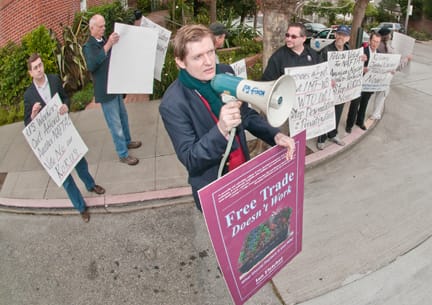
Demonstrators gathered in front of House Minority Leader Nancy Pelosi’s San Francisco residence Jan. 29 to protest her support of the Korean-U.S. Free Trade Agreement, which if passed would represent the United States’ most significant free trade agreement since NAFTA was implemented in 1994.
By Elliot Owen
Contributing Writer
Demonstrators gathered in front of House Minority Leader Nancy Pelosi’s San Francisco residence Jan. 29 to protest her support of the Korean-U.S. Free Trade Agreement, which if passed would represent the United States’ most significant free trade agreement since NAFTA was implemented in 1994.
The agreement, called KORUS FTA for short, is scheduled for congressional debate in the coming months. It seeks to promote the increased trade of goods and services between South Korea and the U.S. by significantly decreasing or eliminating tariffs on about 95 percent of consumer and industrial goods within three years of implementation.
Tom Lacey, chair of the Peace and Freedom Party, emphasized Nancy Pelosi’s history of supporting agreements like the KORUS FTA at the Jan. 29 rally.
“Most of us remember that Nancy was known as ‘NAFTA Nancy’ when she voted in favor of NAFTA the first time around,” he said.
President Barack Obama expressed support for the agreement in his 2011 State of the Union Address, saying it would support 70,000 American jobs as part of a plan to double U.S. exports by 2014.
And the U.S. International Trade Commission reported the reductions made on tariffs would add $10-12 billion to the annual U.S. gross domestic product and about $10 billion to yearly merchandise exports to Korea.
John Brinkley, Communications Director at the Korean Embassy located in Washington D.C., said the KORUS FTA would increase American investment in South Korea in virtually every sector, especially financial services.
“[KORUS] is a very fair agreement,” Brinkley said, stressing that mutually beneficial business interests are being secured.
The protesters at the Jan. 29 demonstration did not share these sentiments.
“This is a job killing bill. It’s awful for workers,” Director of the California Free Trade Coalition Tim Robinson said. “Over 400,000 jobs in the sectors most vulnerable to job loss due to this agreement are in California.”
Additionally, according to the Economic Policy Institute, a nonprofit Washington D.C. think tank, the KORUS FTA will cost Americans 159,000 jobs over the next seven years.
During the most recent renegotiation of the KORUS FTA held in Dec. 2010, South Korea acquired preferential access to American pork and pharmaceutical markets, while the U.S. secured that up to 25,000 more American automobiles will have access to the Korean market.
The International Union, United Automobile, Aerospace and Agricultural Implement Workers of America have publicly approved the agreement while other large unions such as the American Federation of Labor and Congress of Industrial Organization and the United Steelworkers have opposed it.
Steven Zeltzer, chair of the United Public Workers for Action, expressed concern over what he called the deregulatory and pro-privatization nature of the KORUS FTA.
“[KORUS] will be good for multinational companies to flood Korea,” he said. “This agreement is being pushed by the multinationals who are going to benefit from it.”
Zeltzer also said the KORUS FTA could lead to the eventual privatization of the Korean health care system whereby Korean hospitals would be forced to buy high priced drugs from Pfizer and other pharmaceutical multinational corporations.
Protesters argued the KORUS FTA combined with the anti-unionization atmosphere in South Korea would lead to the further repression of the Korean working class, where it is currently illegal to unionize without government consent.
The KORUS FTA was originally drafted and signed in 2007 under the Bush administration but has never been ratified due to ongoing renegotiations.
Pending its approval, the agreement could go into effect by late 2011.