Semester of Justice at City; Speakers discuss LGBT equality and the future of Prop. 8
The first installment of a three-part speaker series called “Semester of Justice” was held for an audience of hundreds of students and faculty on Feb. 10 from 1 to 2 p.m. in the lower level of the City College Student Union.
By Frank Ladra
The Guardsman
The first installment of a three-part speaker series called “Semester of Justice” was held for an audience of hundreds of students and faculty on Feb. 10 from 1 to 2 p.m. in the lower level of the City College Student Union.
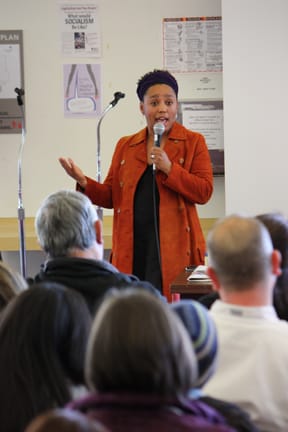
Kate Kendell, executive director for the National Center for Lesbian Rights, along with NTanya Lee, executive director of Coleman Advocates for Children and Youth spoke at the event, titled “Are all civil rights created equal? LGBT rights and unifying civil rights struggles.”
As the meeting commenced, Kendell posed the questions, “What is justice? How is it achieved?” She praised the fact that LGBT equality has seen “lightening speed” progress since she moved to California from Utah to start work with the center 15 years ago.
She recalled accounts of LGBT persons across the nation who had lost their jobs or were beaten or attacked due to their sexual orientation.
“Marriage was nowhere on the radar,” Kendell said. “Domestic partnership schemes were nonexistent. Gay parents could not adopt and had no custody rights. Overall, there was a universal stigma and shame at being gay.”
Kendell said more than 3000 gay/straight alliances exist in today’s educational systems. No longer is it permissible to deny custody of a child on the basis of sexual orientation and most Fortune 500 companies have domestic partnership protections. But most importantly, Kendell said, gay and lesbian visibility is up.
While the Defense of Marriage Act is still in effect, gays continue to have no federal marriage protection. Kendell said much of the country is still vastly homophobic, and that gaining legal marriage equality cannot change everyone’s hearts and minds.
Citing instances of homophobia and misunderstanding, Kendell referred to Supreme Court case Romer v. Evans, where Justice Antonin Scalia inferred that gays and lesbians have plenty of political protections and power and do not need any more.
Kendell suggests LGBT activists make visibility a top priority. She says the nation’s stereotype for a “gay person” often refers to an affluent white person living in an urban area. Yet, statistics show the highest concentration of lesbian moms is in Oakland, and Texas has the highest concentration of Latina lesbians.
Kendell believes measures like Proposition 8, which made same-sex marriage illegal in California, are successfully tackled by unifying gay organizations with various other minority groups and elevating people of color to leadership positions.
“We need to partner with other organizations and make sure to provide an inclusive message that the gay rights struggle is a civil rights struggle encompassing all of us,” Kendell said.
Second speaker NTanya Lee said her organization is one focused around the racial economic justice movement.
Throughout her career, Lee, who is black, said she has felt backlash from whites who are angry about decisions like Prop. 8 and blame people of color for the outcome. She said families of color are concerned with gay rights, but more importantly, they are concerned with quality of life issues, such as lack of quality education.
Lee agrees that there needs to be a broader progressive agenda that unifies all organizations and communities of those discriminated against. She encourages an “inclusive model” that unifies groups by combining common issues, like racial justice, economic justice and gay rights.
Lee also sees the need for more autonomy and visibility in leadership roles in gay rights organizations.
During a question and answer session after the speech, Kendell discussed the current status of Prop. 8.
She said if the law is defeated in the Supreme Court, it will be an issue of constitutionality because it eliminated a right of a minority by the majority.
Kendell does not believe the court will rule on a federal level that forces all states to recognize gay marriage, though.
“That is a battle set for a different time and place,” she said.
Email:
fladra@theguardsman.com