‘Student Journalists Can Make Powerful Change’: Reporters and Lawyers on the Fight for Press Freedom
Student journalists, lawyers and free press advocates assembled to discuss overcoming censorship, surviving arrests and challenging restrictions on free speech.

In a year of unprecedented attacks on First Amendment rights, over 80 students and educators gathered at the University of California, Berkeley’s North Gate Hall on Wednesday, Sept. 30, for a series of three panels on press freedom and student journalism.
Former New York Times reporter and Berkeley law professor Jonathan Glater moderated the first panel of three lawyers who are actively involved in cases defending free press and serve on the board of the Student Press Law Center.
Katie Fallow, deputy litigation director at the Knight First Amendment Institute, discussed a March 2025 lawsuit on behalf of the American Association of University Professors that challenged the Trump administration’s policy of targeting noncitizen students and faculty who engaged in pro-Palestinian speech.
“The government couldn’t just come in and say ‘you can’t engage in pro-Palestinian speech or write an op-ed,’ but they were using very intense threats and imprisonment to obviously chill speech,” Fallow said.
According to lawyer Matthew Cate, the effects of chilled speech were felt in student newsrooms across the country as sources went quiet out of fear of retaliation. In August 2025, The Stanford Daily sued Secretary of State Marco Rubio and former Homeland Security secretary Kristi Noem, alleging that the Trump administration revoked visas and deported international students based on their pro-Palestinian viewpoints.
“With SPLC’s help, I was able to put this brief together with dozens of student newsrooms all across the country to stand up for The Stanford Daily,” Cate said. “One of the lessons that was inspiring to see as we were putting these arguments together for the court is that there’s power in numbers.”
The Stanford Daily won its lawsuit and U.S. District Judge Noël Wise ruled that the statutes Rubio used to deport student immigrants based on their speech were unconstitutional.
“If the First Amendment stands for anything, it stands for the notion that the government can’t pick and choose who can speak based upon what messages it likes and doesn’t like. The government can’t use the power of the state to retaliate against speakers,” said Katie Townsend, a partner at Gibson Dunn representing The New York Times in a free speech lawsuit against the Pentagon.
During the second panel, SPLC senior staff attorney Jonathan Gaston-Falk guided student journalists through best practices for covering protests. He emphasized reporting with a buddy and citing California Penal Code section 409.7, which permits news representatives to enter closed areas at protests.
Dilan Gohill, Stanford Daily news managing editor, described his experience getting arrested in June 2024 while covering a pro-Palestinian protest on Stanford University’s campus. Despite clearly identifying himself as a member of the press, he was detained by the Stanford Department of Public Safety and the Santa Clara County Sheriff’s Office.
Gohill spent 15 hours in the Santa Clara County Main Jail and was charged with felony burglary, vandalism and conspiracy. Santa Clara County’s district attorney dropped the charges in March 2025, nine months after a coalition of free press organizations issued a letter defending Gohill’s right to report on breaking news.
SPLC senior legal counsel Mike Hiestand presented the third panel featuring Berkeley journalism student Ara Rosenthal in discussion with three Redwood High School student journalists and their adviser for the school newspaper Redwood Bark. Rosenthal had previously interviewed the students and adviser for her Wired article “Teen Reporter Searched for His Community in the Epstein Files. Adults Freaked Out.”
Former Redwood Bark reporter Ben Mueller posted an Instagram carousel in February 2026 listing Marin County towns mentioned in the Department of Justice’s Epstein Library. Almost two weeks later, the student newspaper’s adviser, Erin Schneider, received an email from the principal stating that a person named in Mueller’s post was threatening to sue the school district.
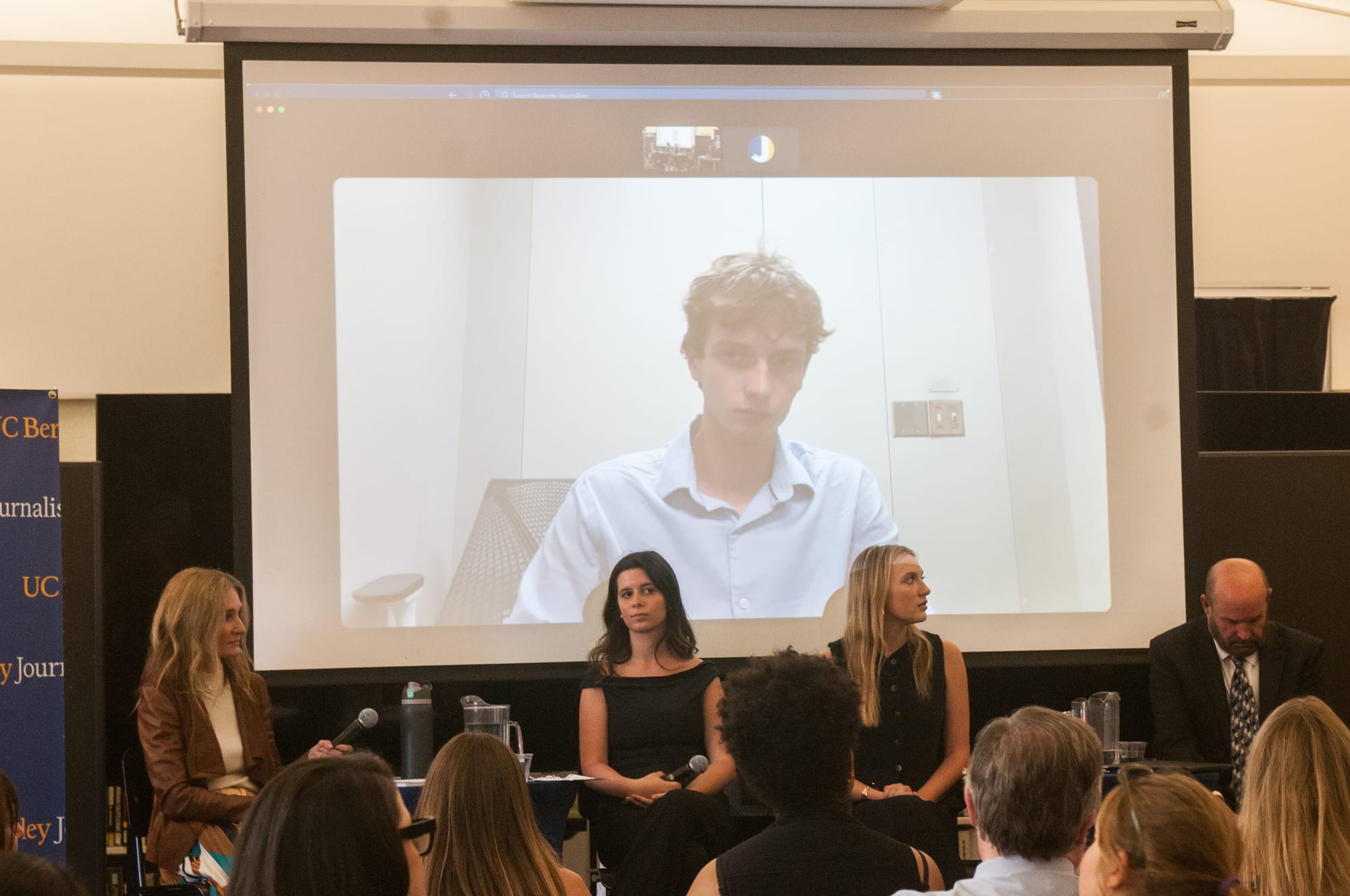
“Erin, Ben, Madison [Bishop] and I worked painstakingly to ensure that there was nothing in our reporting that could lead to a legal situation. We were pretty set in our decision, but we did decide to pause the slide temporarily before we could get more information,” said Penelope Trott, Redwood Bark’s features editor at the time.
“On our lunch break, we called SPLC and talked with Mike Hiestand. We knew that our rights were protected in California and we felt a lot more assured going into our meeting with the school officials to advocate for ourselves,” former social media editor Bishop said.
During their meeting, the students were surprised to learn that the administrators hadn’t even fact-checked Mueller’s post against the Epstein Library. Mueller took out his phone, pulled up the database, and showed the document referenced in his reporting.
“I think that definitely proved to us that students have the upper hand in media literacy, although it’s not a competition. Just because you’re a high school newspaper doesn’t mean you have to write about cafeteria food all the time. You can look into your community, look into legal documents, and hold your community accountable,” Bishop said.
Mueller and Bishop were able to restore the original Instagram post, but the meeting left Mueller shocked by how little faith the school’s administration had in student journalism. For Schneider, this was the third time in the past year the district had interfered with Redwood Bark’s reporting. She decided to take a leave of absence from the journalism program in March 2026.
“We’ve got all of these students who are doing passionate work and when they have someone from the top come and squash those ideas or tell them that they’re not doing the right thing, it gives us a chilling effect and makes us wonder what strength we do have,” Schneider said.