The Debut Memoir of a Poet: Book Reading and Discussion at Mission Center
A writer revisits her war-torn past, leading readers through her journey of transformation.
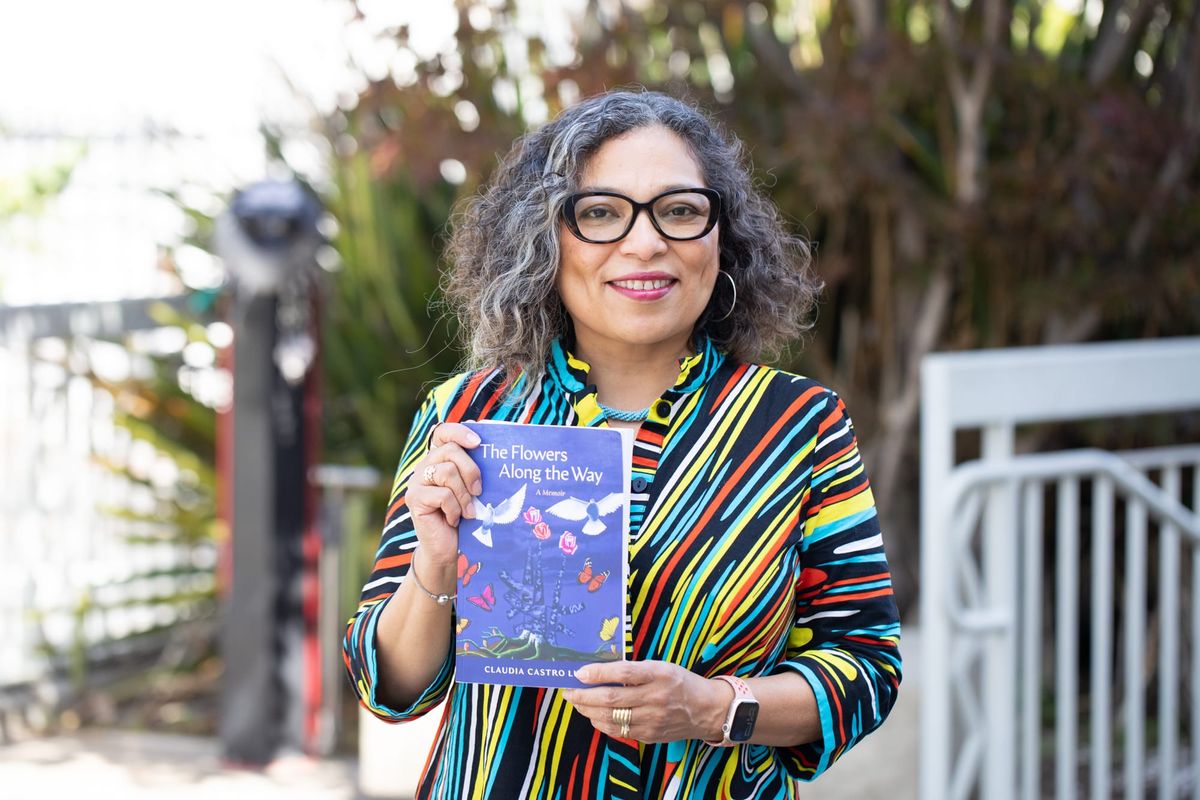
Butterflies and white doves flying over a deep blue night sky. On the ground, small oval-shaped cocoons scattered next to riffles that take root, becoming a tree covered in colorful blossoms. An art filled with symbolism, telling a story of hardship and loss, but also of transformation.
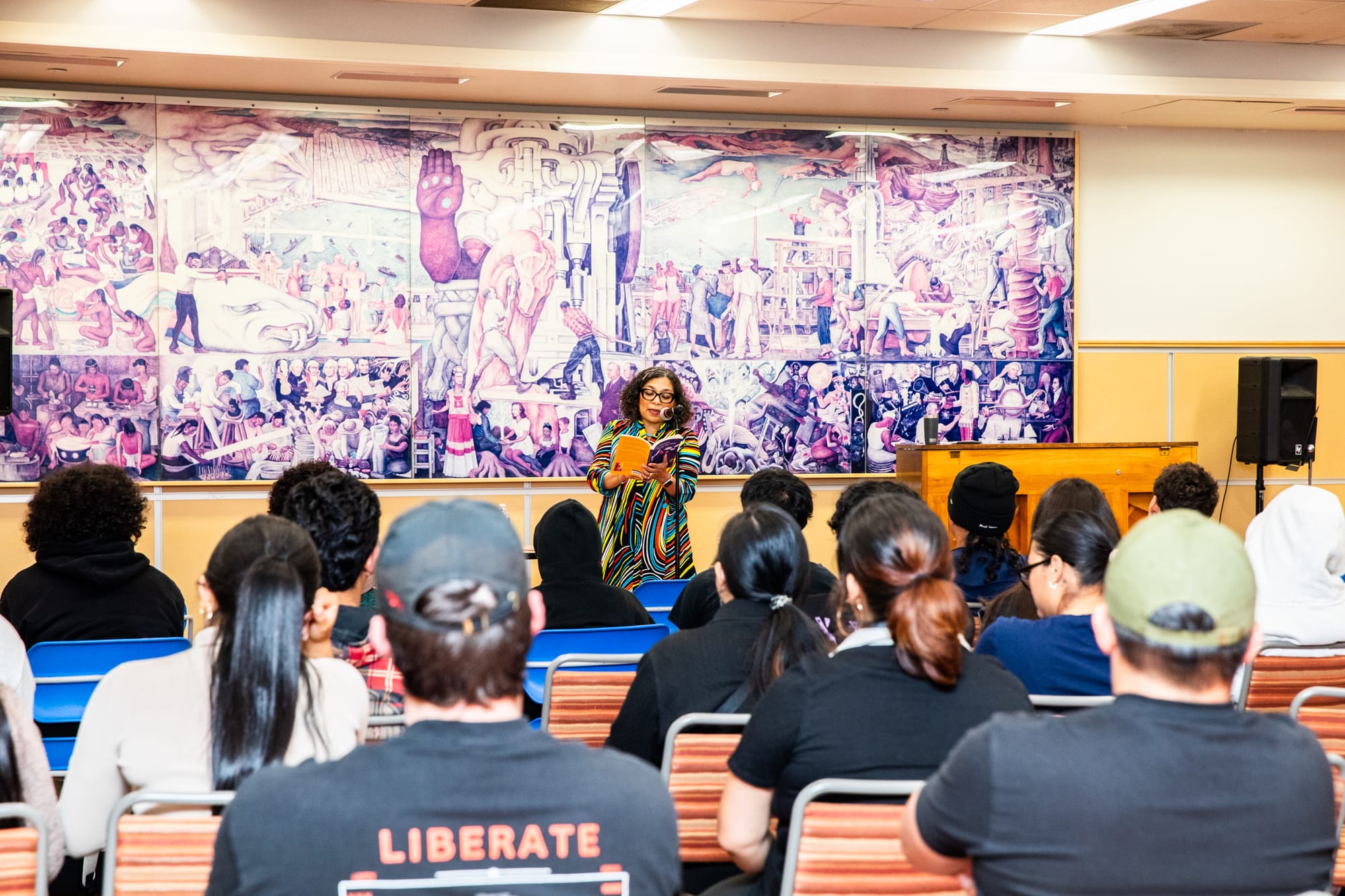
The art is stamped in the cover of the book that Claudia Castro Luna, an award winning writer and poet laureate, read before a group of students attending her memoir discussion at the Mission Center on Sept. 24. The event was sponsored by the Puente Project, a two-semester writing course that features Mexican American/Latinx and other multicultural authors, experiences, and issues.
Past and Present Collide
“The Flowers Along the Way,” released on Sept. 15, is Luna’s debut memoir. It takes the reader on a journey through her childhood in El Salvador, and her early years as a mother living in Oakland, California.
With vivid descriptions of El Salvador's landscape, Luna narrates her childhood years in a country formed by lush forests, deep blue mountains, a variety of fruitful trees and the memories of her family and rich culture.
In those early years, Luna was met with all the beauty that her homeland and community could give her, a sense of belonging and wonder that later encountered the horrors of civil war.
“El Salvador is very beautiful,” said Luna. “The descriptions I give are so vivid because it is a beautiful place.”
Nature is central both in her past in El Salvador and in her present days living in Oakland.
“Nature plays a role of both anchoring us in place, but offering images and sounds that are hopeful. So the beauty was always there,” Luna said. “We were in a war, but the plants were there, the birds were there, and they met us on the other side where we came out of that war, into the present time.”
Luna shared with her audience the horrors of the civil war and how the state-inflicted violence affected those close to her and her family.
During the war, which lasted from 1979 to 1992, the government used military power to exert violence against civilians, killing thousands. As a daughter of two teachers, Luna witnessed the deaths of her parents’ colleagues and friends.
Luna and her parents knew it was only a matter of time until the state went after them, and they decided that fleeing to another country would provide their best chance.
“I came to the U.S. in 1981, as a 10th grader in high school,” Luna said.
Years later, in north Oakland, Luna, who was pregnant, found herself hiding among the bushes with her daughter as gunfire erupted outside her house. That moment awakened memories of the war and trauma she had experienced as a child.
It is through this collision of past trauma and present circumstances that Luna takes the reader on a journey through the struggles of trauma, displacement and violence toward transformation and redemption.
The Process
It took 12 years for Luna to write the memoir. “The first stories were at Mills [College in Oakland]... I was studying poetry because I'm a poet, but the writing for the memoir, I felt, needed to be prose,” Luna said.
Luna has written about her childhood in El Salvador in other works of poetry, like in her poetry collection "Cipota Under the Moon," published in 2020.
But Luna felt that the narrative of a memoir was not suited to the form of a poem.
“I've attempted to do some of that in poetry, but it's a very complicated story. And so poems are very compressive,” Luna said. “You need kind of that [narrative] arc, that sometimes poetry just doesn't offer you. That's when I realized I needed to tell this in prose.”
Luna says that the memoir made her a better writer. “I became a writer by writing this book,” she said,“because I really learned the craft of prose writing.”
The poetry was not left behind. Luna's vivid descriptions and clever use of language and images make their marks throughout the book.
“That's what poetry does, because you're working with images a lot. And so all of those craft elements from poetry are definitely working in the book,” Luna said.
After many suggestions for titles, “The Flowers Along the Way” fits well with the story that the memoir tells.
The cover illustration, made by an artist in El Salvador, is filled with symbols that reflect the memoir's narrative.
“It was perfect. When the press showed it to me, I said, ‘Fantastic!’” Luna said, “They did the work of contacting the painter and he said, okay, I will give you the rights for the image.”
Transformation
Butterflies were once caterpillars that passed through a process of transformation. Revisiting the memories of such a traumatic past was a very difficult task for Luna.
“I lived with this very traumatic material for a long time in order to tell it,” Luna said. “But the other side of that, I really emptied my life in El Salvador in this book, you know? And it really carved me up inside.”
The book may not have erased the horrors and trauma of the war, but it gave Luna a chance to see and understand her story. “That also meant that those deep wells of sorrow and loss were now open to be filled with hope, and with moving forward.”
"The end of the book is very hopeful,” said Luna, “and there's a lot of music and lightness at the end, and redemption, and of coming into myself. There is a lot of wholeness in the end.”
Hope
Salvadoran students present during Luna's reading were able to learn a little bit of El Salvador's past. One of the reasons for writing the book, she said, was to reach those Salvadorans born in different parts of the diaspora who didn't experience the civil war.
The event was co-sponsored by Puente, a transfer and leadership program, and by City College’s creative writing program, to help students in their own writing journey.
Steven Mayers, Puente's coordinator and an instructor in the English Department, stated through an email that Luna's poems and some excerpts of her memoir have been discussed in their classes.
“Her experience fleeing her home in El Salvador and migrating to the US, and then dedicating her life to teaching and writing, is an inspiration to our students,” Mayers said. “[It] connects to our class' theme on reclaiming narratives.”