Tough-to-swallow evaluation and budget dominate meeting
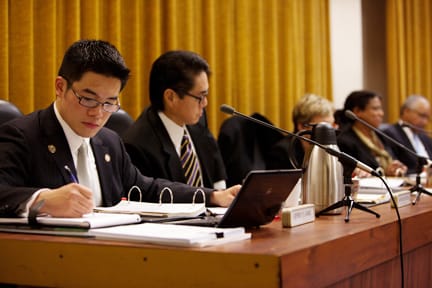
The City College Board of Trustees elected John Rizzo and Chris Jackson as the new president and vice president at its Jan. 27 meeting, which also included the results of the the board’s recent self-evaluation.
By Emily Daly
The Guardsman
The City College Board of Trustees elected John Rizzo and Chris Jackson as the new president and vice president at its Jan. 27 meeting, which also included the results of the the board’s recent self-evaluation.
An informational handout stated the self-evaluation results were made up of responses from constituent groups like the Academic Senate, American Federation of Teachers Local 2121, Classified Senate and the trustees themselves.
Pamela Mery, a representative from the Research and Planning Office at City College, presented the results of the self-evaluation. Questionnaires had been distributed to the trustees at the previous board meeting, and all responses were anonymous.
Responses were meant to refer to the period of July 1, 2009 to June 30, 2010.
The results were put into two categories: qualitative, consisting of comments to open-ended questions, and quantitative, consisting of numerical ratings averaged from one to five.
In the quantitative section, constituent groups rated the board 3.02 for board organization, 2.93 for community relations, 3.0 on policy direction, 3.05 on standards for college operations, and 2.73 for board leadership.
The qualitative results stirred the most discussion. Open ended comments from the trustees showed a wide range of opinions, from “a majority of board members work hard” to “at this point in time, I find no great strengths in this board.”
Former board president Milton Marks expressed concern as he read aloud some of the open-ended comments from the constituent groups like “The board is rude, crude, and disrespectful … The board is completely dysfunctional.”
“I find these to be disturbing,” Marks said.
Another negative comment read, “While individual board members can be thoughtful and even caring, collectively the current board is a train wreck.”
However, the board received more than just criticism. The constituent groups listed the board’s major accomplishments of the past year as supporting the DREAM Act, not firing employees during the financial crisis and working on the budget.
The board was also praised for its diversity and sincere concern for students.
But other seemingly facetious comments showed clear frustration at the board’s perceived lack of focus.
When asked what the board’s major accomplishments were, answers included “showing up for photo opportunities,” “grandstanding against the college for personal political achievement” and “surviving each meeting without resorting to violence.”
Trustees’ comments about areas in which the board could improve related mostly to making sure meetings were shorter and more effective, and being open to compromise. The board’s comments showed that they felt they should make budget issues a priority for the new year.
The longest comment by a trustee addressed issues of mistrust between the college community and the board, and accusations of micromanaging. The comment stated that these issues arose after three former administrators were charged with multiple felony accounts for their misuse of district funds.
The comment also addressed the relationship between administrators and board members, specifically that college administrators are major campaign contributors to certain board members, and have given more than $32,000 to certain members.
After discussing the results, most board members seemed to welcome the feedback.
“I think this is very, very valuable for the board,” said Trustee Lawrence Wong.
Academic Senate President Karen Saginor said the faculty has a “somber mood” while planning what to do with the reduced budget for the 2011-12 fiscal year.
Saginor also noted the Academic Senate is continuing to work with the administration over the issue of website access. Certain websites cannot be accessed from the school because of their content, although students and faculty may legitimately need information on the websites.
Chancellor Don Griffin said it was crucial the board look at the budget as a 17-month problem in order to make sure the school stays afloat over the budget problem in 2012 and 2013, and the board and administration need to come up with a plan of action concerning the budget in the next 30 days. He also said the college would have to raise a tremendous amount of money locally.
The board passed a resolution requesting the City and County of San Francisco to suspend City College’s fees and provide aid to the college.
Highlights of Griffin’s report included news that Gov. Jerry Brown put the Performing Arts Building in the state budget proposal using 2006 bond funds, and that a “robust” City College summer session is planned for 2011.