Trading the Planet's Ozone Layer for Better Internet Connection
We are destroying our planet's atmosphere with every piece of tech sent into orbit.
On a June evening during a weekend camping trip near the Lower Bear River Reservoir, a friend needed to send directions to someone arriving at the campsite early the next morning. He walked down to the road, held his phone in the air and waited for “Satellite SOS” to appear on the screen.
Smartphones running Android 15 or later can connect to satellite-based internet through Skylo, a network service provider based in Mountain View, California. Once a nearby satellite was located, he tilted and waved his phone to get the best signal. He could only stay connected for a minute, but it was long enough to send the campground’s address and a grocery list for paper towels, lighter fluid and chocolate bars to the group chat.
While space-based internet allowed my friend to contact another camper, the technology behind the text message is causing a new set of problems for Earth. Is remote internet access worth destroying part of the planet?
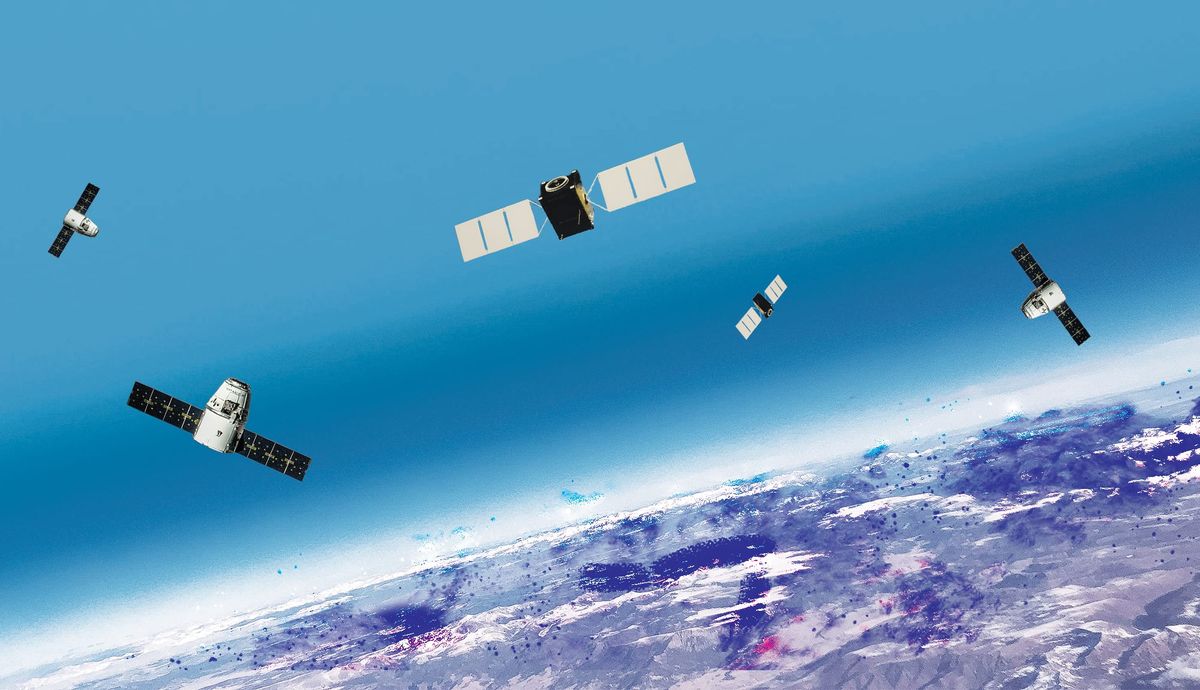
Just a decade ago, there were a little over 1,000 active satellites in orbit around the Earth. That number has jumped to nearly 17,000 as of Sept. 17, 2026. Over 11,000 are Starlink communications satellites used to provide internet in remote locations. While Starlink has somewhat achieved its goal of providing high-speed internet to remote locations around the world, the emissions from falling satellites and the SpaceX Falcon 9 rockets that hurl them to space pollute every layer of Earth’s atmosphere.
And Starlink isn’t alone. Jeff Bezos’ rocket company, Blue Origin, is planning to deploy at least 3,000 satellites while companies in France and China are developing their own satellite megaconstellations.
From the air we breathe in the troposphere, the lowest level of the atmosphere, to the stratosphere, where commercial airplanes fly almost 8 miles above Earth’s surface, dying satellites and the products of burning rocket fuel are changing our planet for the worse.
In order to build a megaconstellation, aerospace companies book a ride on the next outgoing rocket to send a new batch of satellites to space. On launch day, a rocket burning refined kerosene will lift off from the ground, belching plumes of carbon dioxide and chlorine into the troposphere.
As the rocket ascends through the sky towards space, it burns through fuel contained in detachable stages, as well as assist engines called boosters. The burning fuel sprays tiny particles called black carbon into the upper layers of the atmosphere where they can linger for decades. In the stratosphere, black carbon absorbs sunlight, warming up the air around it and destroying the ozone layer.
Once the fuel is spent, the empty boosters and stages fall back to Earth and heat up from friction with the rushing air. The combination of heat, metal and oxygen creates noxious chemicals called nitrogen oxides that also eat away at ozone molecules.
The satellites that are launched into space can’t operate forever. After about five years, they go through an end-of-life phase called “deorbiting.” The now space junk propels itself towards the mesosphere, a layer of the atmosphere where meteors burn. As the junk falls, friction causes the surface to heat up, releasing toxic chemicals containing metal and oxygen. Some of these metal-oxygen compounds like aluminum oxide condense into larger particles that drift down into the stratosphere, further harming Earth’s protective ozone layer.
Earth without an ozone layer is like a person without sunscreen on a hot, sunny day. Burnt. And satellite companies seem more than willing to repeat the endless cycle of launching, deploying, deorbiting and destroying regardless of the long-term effects on the planet they live on.
Using alternative fuels like liquid natural gas or hydrogen might help reduce black carbon emissions from rocket launches, but falling stages and boosters and dead satellites will still rain down into the upper atmosphere, degrading the ozone layer bit by bit.
In the near future, we might have satellite-based internet available in the most remote places on the planet, but our lives on Earth will be unrecognizable.