Undercount costs California House seat, federal funds
California officials estimate the U.S. Census Bureau undercounted at least 1.5 million state residents, according to the Los Angeles Times. Officials also believe the undercount could have cost the state an extra House seat.
By Yomi Akinyemi
The Guardsman
California officials estimate the U.S. Census Bureau undercounted at least 1.5 million state residents, according to the Los Angeles Times. Officials also believe the undercount could have cost the state an extra House seat.
The census declared the state to have 37.3 million residents, but according to a report by the Los Angeles Times, data from the state Department of Finance shows California’s population was 38.8 million on July 1, 2010.
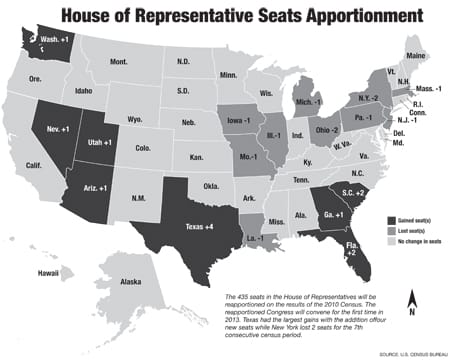
Apportionment in the U.S. House of Representatives is based on census figures. The 2012 reapportionment will affect 18 states, and 12 congressional seats will be reassigned to representatives in the 113th Congress, which begins Jan. 1, 2013.
Sun Belt states Arizona, Georgia, South Carolina, Utah and Nevada will each gain one seat, while Florida adds two. With approximately 4.3 million new residents in the recent census, Texas gained the most of any state with four new seats. Louisiana is the only Sun Belt state to lose a seat.
Illinois, Pennsylvania, Ohio and New York are among nine Midwest and Northeast states to lose seats.
City College political science professor Richard Baum said the litany of congressional losses in Democratic stronghold states has given Texas and other Sun Belt states more say in future presidential and congressional elections. These states, who tend to vote Republican, will also have more electoral votes in 2012.
“If the 2012 Presidential election is close, this could be a big problem for Obama getting reelected,” Baum said. “In states like Texas, with a winner-take-all electoral college based on the number of popular votes, the electoral college could be to his detriment.”
The once-a-decade redistricting, Baum said, is a win for Republicans who gained more governorships and offices in state legislatures across the nation and will draw districts that will generally favor them. But the effect of a rise in Hispanic population — who, according to the Pew Hispanic Center voted 60 percent in favor of Democrats during the mid-term elections — could also hurt Republicans in the Sun Belt.
Baum said in theory, the recent election results show the shift of power in U.S. politics as Southern state politicians have become more powerful. “Yet the population makeup of these states could result in a rise in elections of more conservative Democrats,” he said.
In April, the census will release local data that will be used, if needed, for redistricting purposes.
Locally, federal law states that newly drawn districts must fit the city's geographic landscape and have about the same number of residents. More importantly, the districts must adequately reflect the demographics of the community.
Baum said that although there are strict guidelines to prevent gerrymandering, there are several methods legislatures use to benefit their party. Instead of drawing lines that ostensibly favor them, the ruling party can redistrict to weaken the opposition party strongholds and capitalize on the new up-for-grabs districts.
The Los Angeles Times report also states that California officials believe undercounting in the last decennial census cost the state about $1.5 billion in federal funds allocation.
The Brookings Institution, a nonprofit public policy organization, stated that about 20 percent of state government budgets come from federal grants, and erroneous census data costs states a portion of the $447 billion annual federal funds disbursed.