Unique perspective leaves ‘No Exit’ for viewers
The high frequency pitch of a steel door being vacuum sealed, an ominous voice addressing the audience and screams erupting from fires – these are the commencing sounds for the play “No Exit” at American Conservatory Theatre on Geary Street in San Francisco.
By Isaiah Kramer
The Guardsman
The high frequency pitch of a steel door being vacuum sealed, an ominous voice addressing the audience and screams erupting from fires – these are the commencing sounds for the play “No Exit” at American Conservatory Theatre on Geary Street in San Francisco.
Welcome to L’Hôtel, a stage manifestation of Jean-Paul Sartre’s vision of hell – other people.
The Virtual Stage and Electric Company Theatre has taken Satre’s play to the multimedia age and tested its relevance by asking, “Has human nature changed?”
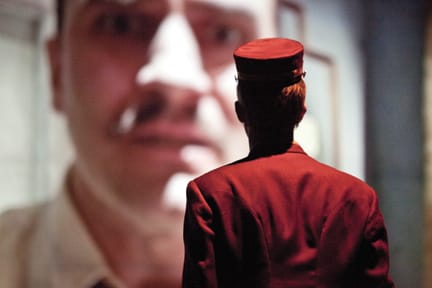
Introducing the piece with playful banter, the valet, who serves as a mediator between audience and actors, states the show will go on for eternity as long as the audience is there to watch it.
He is alluding to much more than ticket sales.
The VSECT production of “No Exit” turns everything inside out. Traditionally, Sartre’s play about the afterlife locks three strangers in a room for all of eternity. The fourth character, the valet, makes only brief appearances.
In this Canadian interpretation of “No Exit,” the valet’s abode becomes the stage. A closed-circuit television screen background depicts the leading characters, each in his own frame, seated, isolated and trapped within the adjacent room by a quadruple-bolted steel door.
They expect to be whipped, thumb-screwed and tortured. Instead they are just left there, gradually realizing that to be stuck with each other is their ultimate punishment.
The stage, which the audience may view after the end of the play, is painted robin’s-egg blue and contains three mismatched chairs, a bust of Julius Cesar, a mustard-colored drape that covers a window sealed off with bricks and, hidden to the audience, four cameras.
A static camera captures the actions of each character. As they jumble, interact and torture one another, the camera depicts what happens in each isolated box, thus adding another dimension to the “trapped inside a box” theme.
“I did not set out to create a live film; rather this form emerged from the desire to fulfill the plays demands and truly lock up the three characters together,” director Kim Collier wrote in the play’s program.
The integration of film and theater lets the audience experience the sense of claustrophobia and desperation on the actors’ faces, evident even from the balcony level. Countenance becomes just as important as body language.
Sartre’s characters are enduring because they are not mere archetypes; they are original creations. Their evil deeds are rooted in vanity and selfishness but also self-consciousness.
Their insecurities are a mirror for the audience.
The valet’s role serves to alleviate some of the tense drama between the three tortured souls who pick and prod at each others’ sins, misdeeds and neuroses.
Most importantly, though, the valet is trapped in his own hell. For all eternity he must repeatedly lock these three people together as long as the audience “sees themselves in the characters.” Only when the audience no longer relates to the trapped characters will the valet be irrelevant and thus free from his torment.
Email:
ikramer@theguardsman.com