Behind Closed Doors: Transparency Gaps Leave Public in the Dark
The college faces questions over closed-session agendas and delayed public records
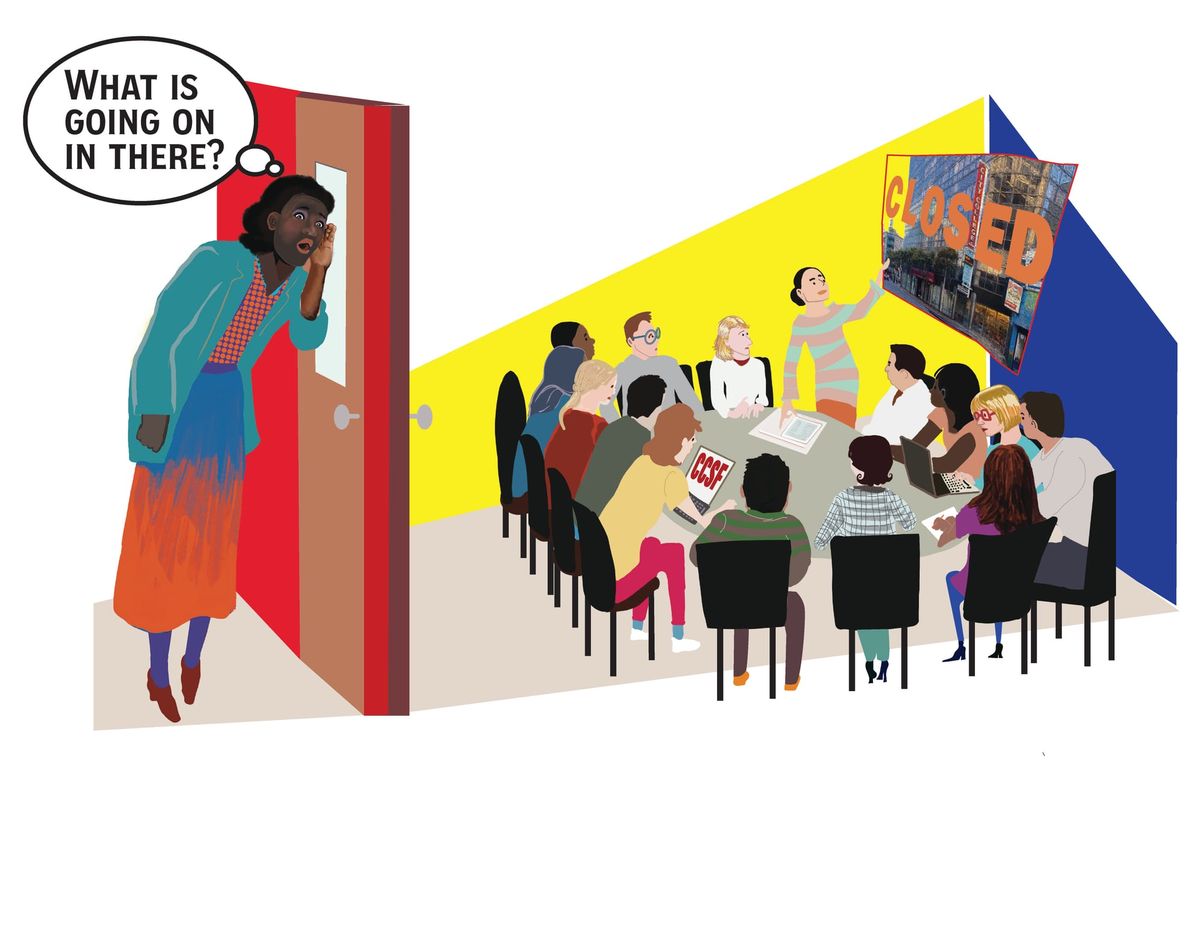
City College of San Francisco’s use of broad closed-session agenda language and a delayed public records response have raised questions about whether the college is giving the public enough notice and access under state transparency laws.
Some public meeting agendas have not given advance public notice of items to be discussed, as required by law. The college has ignored public record requests. The website for said requests is misleading and uncorrected.
In February, the chancellor made the surprise announcement that the college was ending classes at the Downtown Center. What was going to happen with the building after the classes ended?
The Guardsman staff planned a series of articles on the center. It was hard to get anyone to answer questions — not the dean, the chancellor or the facilities department.
“Potential Real Estate” appeared on several recent Board of Trustees “closed session” agendas. Were they discussing the future of the Downtown Center? It seemed possible.
Transparency laws do allow for some things to be discussed in closed session, such as real estate negotiations, along with lawsuits, labor, personnel and discipline issues.
But a particular bit of state law, Government Code 54956.8, says that before the closed session, they must publicly identify “its negotiators, the real property or real properties which the negotiations may concern, and the person or persons with whom its negotiators may negotiate.” The agendas did not provide these details.
Amy McClellan, the college’s new general counsel, wrote, "That entry is a standard placeholder used to preserve the Board’s ability to confer with its real property negotiators if a qualifying matter were to arise. It does not indicate that a discussion will occur at any given meeting.” She also said that, in fact, no real estate matters had been discussed at those meetings.
The First Amendment Coalition, when asked, said the use of “placeholder” blank agenda items like that does not give the public enough advance notice of what might be discussed to meet the legal requirements.
McClellan didn't respond to follow-up questions about this.
The issue comes as this newspaper has also sought records related to construction-related student parking losses on Ocean Campus.
What has been the impact of reduced student parking?
The Guardsman made a formal public records request for parking-related records.
The law requires a response within 10 days, but it took almost two months to get the info.
“For media inquiries and CPRA requests, please email ccsfmediarelations@ccsf.edu,” according to the college’s website. We discovered that no one actually answers this email.
Chancellor Kimberlee Messina and her assistants made promises. It was punted to Police Chief Mario Vasquez. He said he’d look into it.
Finally, McClellan sent the requested documents and data. She said she is now the person to whom public records should be sent. The media relations website has not been updated at publication time.
The future of the Downtown Center remains unclear.
“The people of this State do not yield their sovereignty to the agencies which serve them. The people, in delegating authority, do not give their public servants the right to decide what is good for the people to know and what is good for them not to know. The people insist on remaining informed so that they may retain control over the instruments they have created.”
- The Ralph M. Brown Act, regarding public meetings, 1953
“The Legislature, mindful of the right of individuals to privacy, finds and declares that access to information concerning the conduct of the people’s business is a fundamental and necessary right of every person in this state.”
-California Public Records Act, modeled on the federal Freedom of Information Act (FOIA), 1968