Living Roof Left to Die
The sustainable rooftop on HBB has gone without necessary maintenance for years
Among the forgotten corners of the Ocean campus is a 20,000-square-foot living roof atop the Harry Britt Building.
In 2010, the college was seeking Platinum LEED certification for the former Joint Use Building, later christened the Multi-Use Building and now the HBB. Along with other innovations, including an array of geothermal wells and automated electronic systems to reduce heating and cooling costs, the living roof was conceived as a way to reduce stormwater runoff while insulating the roof from the sun’s rays.
It also helped the college comply with the City of San Francisco’s Better Roofs ordinance, which required owners of new commercial buildings to install either solar panels or a living roof.
The living roof was installed over a standard waterproof membrane. On top of this membrane, squares of Sedum Tiles were placed. The Sedum Tiles are two inches thick and made from fibrous material that absorbs moisture and acts as the planting medium.
The tiles were delivered to the site already planted with four species of sedum, a low-lying succulent, along with California poppy, lupine, beach grass and sand strawberry. These native plants are adapted to the local climate and require minimal water.
A drip system was installed over the tiles to help keep the plants moist during dry periods and prevent them from blowing away in the wind.
Out of Sight, Out of Mind
The drip system is still in place, but hasn’t been maintained, so it is not known whether it is still operable, according to Ryan Schneider, Chief Engineer for the college. Except for the building engineers, who have to periodically check other equipment mounted on the roof, no one goes up on the roof.
Cecil Hilario, one of the engineers who has been on the roof multiple times over the years, said he has found drones, toy rockets, soccer balls and other items up there. He wasn’t sure when the plants started dying, but the original planted species are now nearly all gone.
One reason the living roof has been forgotten is that it was never meant to be accessible to the public, and it is difficult to see it from Science Hall or the STEAM building. One person who has not forgotten it is Steven Brown, chairman of the horticulture department.
“Living roofs need to be maintained,” Brown said. “I worked for almost a year to get bids,” he recalled, with a touch of frustration in his voice.
According to Brown, the college entered into a one-year maintenance contract for $800 per month, plus the cost of plant replacement as needed. “The Board of Trustees didn’t do their part to keep it up,” said Brown, noting that the Board didn’t renew the maintenance contract.
The roof couldn’t be maintained in-house, Brown said, because workers going onto the roof would need to be trained and certified to work on the roof while wearing a safety harness, and the college didn’t want to go through that. So there was no alternative but to hire a contractor to perform maintenance.
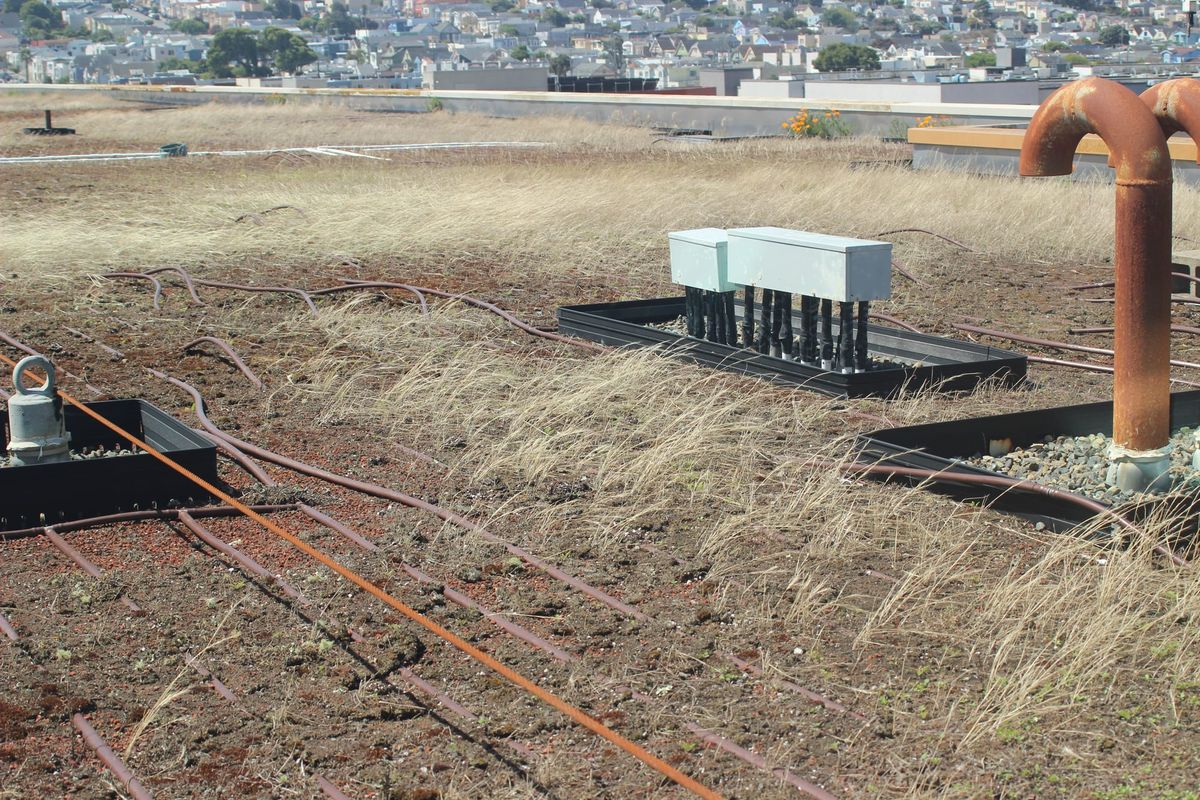
On a recent visit to the roof, The Guardsman observed that the tiles are still in place. Although they show some evidence of shrinkage due to desiccation, none seem to be missing. Invasive grasses and a few weeds, mostly brown from lack of water, sprout from many of the tiles. There was no evidence of the original beach grasses. A close inspection revealed scattered locations where the original sedum has survived. In the southwest corner of the roof are a few bright clusters of orange poppies.
The Price of Neglect
According to Brown, restoring the roof would be costly, and he doubted that the college could find the funds to do it.
The cost to install a living roof like the original one would probably exceed half a million dollars, based on published estimates of about $20 to $30 per square foot. Had the college continued to maintain it, and assuming the maintenance cost remained equivalent to the $800 a month of the original one-year contract over the years, the total cost up to now would have been a little over $200,000 in today’s dollars.
So, the nearly dead living roof continues to cover the HBB. It isn’t beautiful, but even without plants, it continues to function as originally intended.