Students, Faculty Rally Against End of Classes at Downtown Center
Opponents say the decision was made without community input and will drive away enrollment that the college can't afford to lose
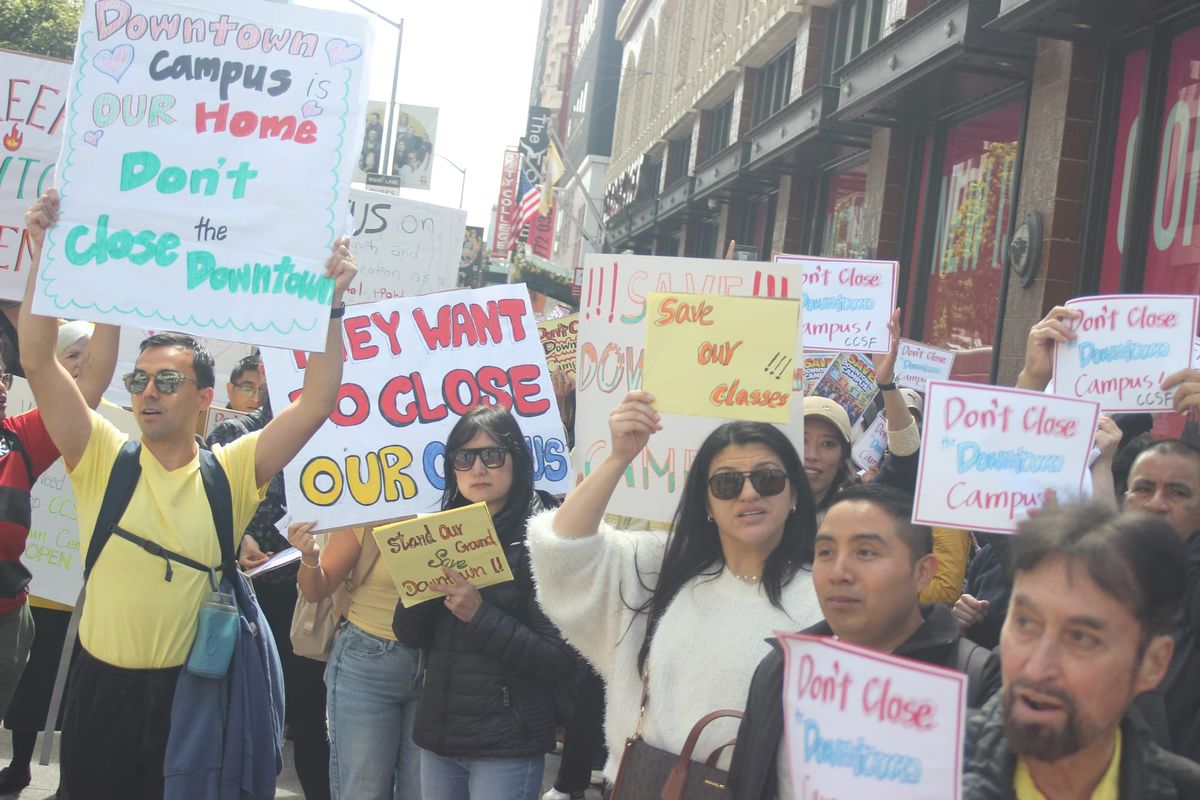
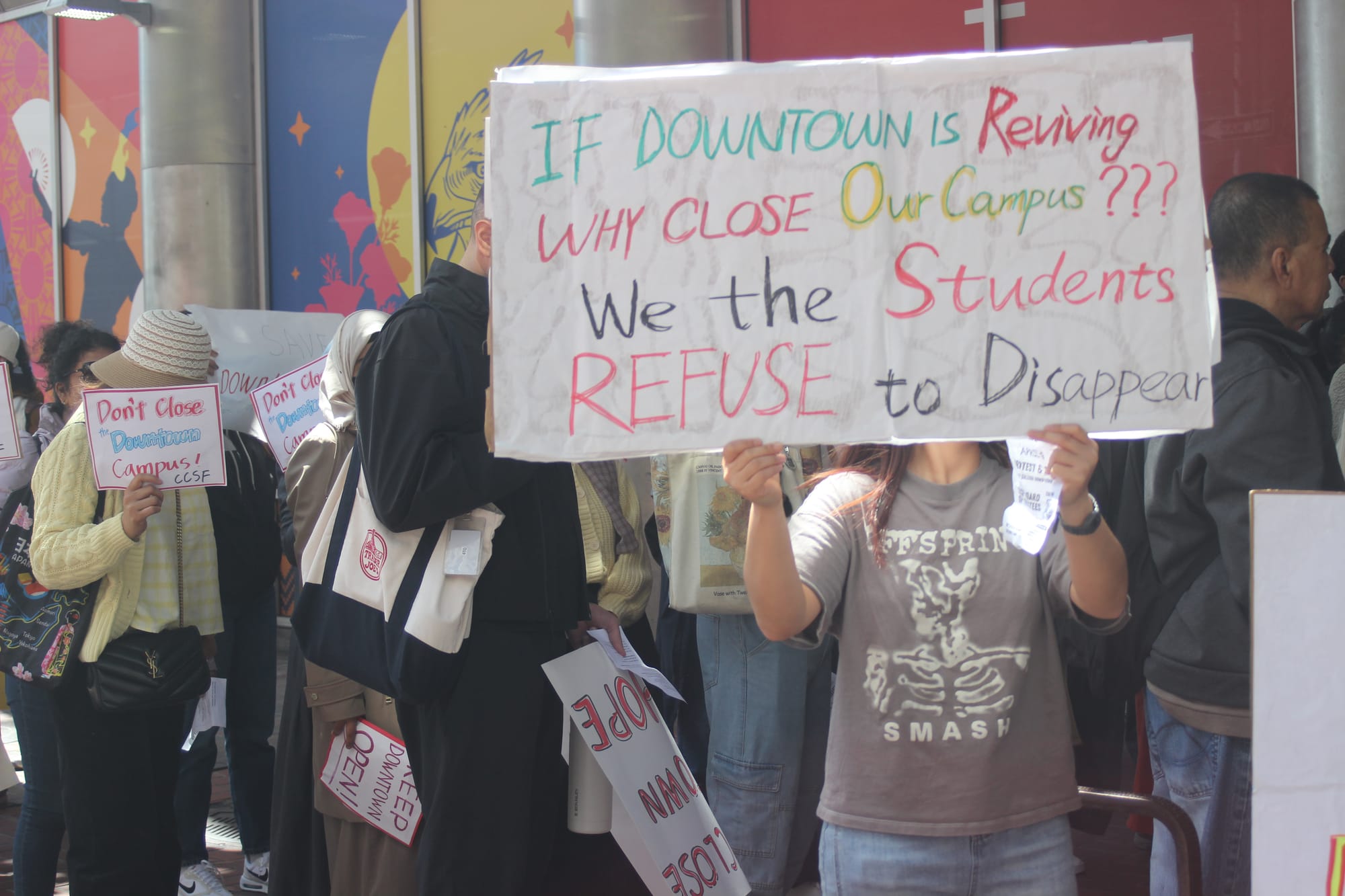
More than 100 students and faculty demonstrated outside City College’s Downtown Center in April, pushing back against the administration’s decision to stop holding classes at the Fourth and Mission streets location after this semester.
The protest, organized by the center’s Associated Student Council, drew mostly ESL students and faculty, along with a few alumni and student leaders.
Malinalli Villalobos, Associated Student Council Executive Committee Vice Chancellor, led the protesters in a short but spirited march from the center to Market Street, where the group crossed Fourth Street, turned mid-block down Yerba Buena Lane and returned to the Downtown Center.
With drums, whistles and hand-painted signs, the protesters attracted the attention of pedestrians and passing motorists, many of whom honked their horns in solidarity.
Sarah Albarakani, along with her friend Sarah Alsamemi, voiced hope and enthusiasm for keeping the Downtown Center open. “I want it open every day,” Albarakani said. “I want to speak English very well.”
A Downward Spiral
Many opposed to the closure expressed chagrin at what they consider a vicious spiral of lower enrollment spurred by fewer course offerings. Emmie Reed, a community health worker continuing her education by taking classes at the Ocean campus, said she heard about the protest in her poetry class and, after reading about the closure in The Guardsman, felt she had to join the protesters.
“Why not offer a diverse group of classes?” said Reed. “Most of the students [at City College] don’t know about [the Downtown Center] because there are no classes offered.” She noted that the Downtown Center is close to BART and very convenient for many students who find it difficult to get to the Ocean campus.
Convenience and proximity to the population served by the center are frequently cited by those who want it to remain open. That population, they say, is largely drawn from the Tenderloin, SoMa and other neighborhoods to the south of Market, and is a distinct “world” population, different from the neighborhoods now served by the Chinatown/North Beach Center.
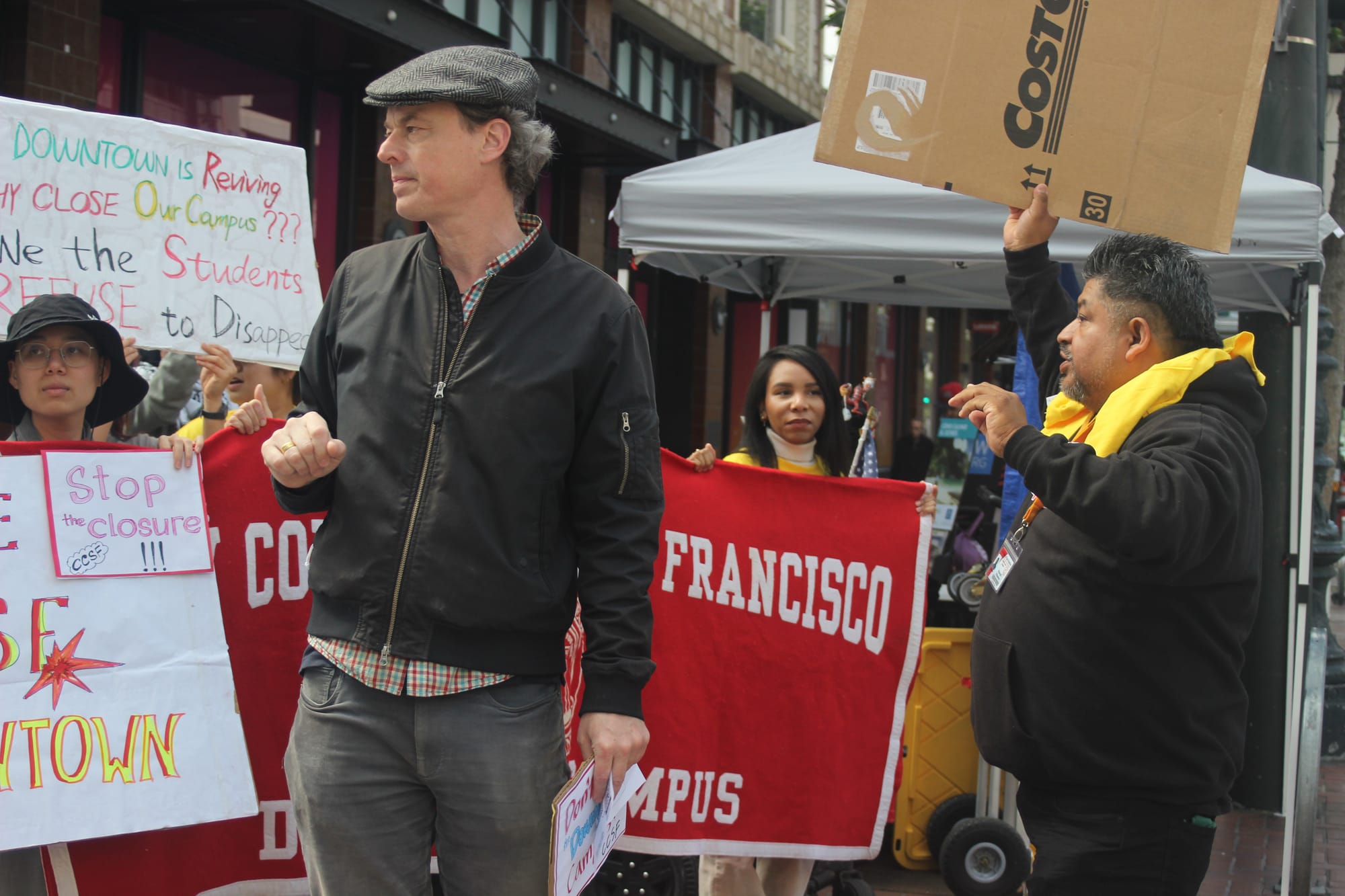
Opponents of the move say that the administration’s plans to move Downtown students to the Chinatown/North Beach Center will result in a loss of enrollment overall.
ESL instructor Sophie Manukova, who has taught ESL at City College for 30 years, was at a table at the center's entrance, handing out literature to passersby. “If we have to, we will move,” she said. “But we prefer to keep the campus open. It’s very convenient to the students.”
Villalobos said closing the center “means closing the doors on thousands of students, not only students right now, but students of the future.” He said the funding formula was not a sufficient reason. "What we need to do is make sure that we find funding to make sure that these doors remain open, thinking outside that box."
Out of the Loop
Opponents of the decision to close the center also complain that the administration has not involved the City College community in the decision-making process. Christa Lewis, the ESL coordinator, noted that alternative ideas for maintaining the center have never been aired, including involving the SF Unified School District in integrating high school students from Galileo and other high schools into college-level courses.
Since online courses have historically been credited to the Ocean campus for purposes of counting full-time equivalent student enrollment (FTES), administrators believe that the state would not allow those online classes to be re-allocated to the Downtown Center. But Lewis said that FTES from hybrid classes with an in-person component could be counted toward Downtown Center enrollment. She also suggested that Galileo or other high schools in the SF Unified District could be a source of enrollment if the college were to expand its high school outreach.
Luisangelo Marcano, a former student council president who attended a town hall at the center on Jan. 28, said students were misled about the administration’s intentions. "They didn't say 'don't worry we're not going to close it,' they said 'don't worry, you're not going to lose your classes,'" Marcano said. When the closure was announced five weeks later, many students were taken by surprise.
Heather Brandt, Associated Student Council chancellor and executive committee chair, said the pattern is familiar. “We do not regain those students,” she said. “It’s really nice to think that our students will go to another location, but there’s a reason that they come to this location.”
Brandt added that the underlying problems leading to the closure have been brewing for a long time, and that students and faculty did not hear specific plans about it until the last minute. “We should have been hearing about this for much longer and should have been trying to tackle the issue a long time ago,” she said.
For its part, the administration has framed the closure as a temporary measure and suggested that the building may be leased to outside programs to generate revenue, although no specific options have been proposed.