City College's Forensics Team provides opportunities beyond the classroom.
Charlie Garcia-Spiegel had to take a required public speaking course, but he didn’t think he really needed it. Then, his professor recommended he check out an intramural speech and debate tournament run by the City College Forensics team.
“I signed up for the team and I fell in love with it very quickly, and I’ve been here ever since,” Garcia-Spiegel said.
Now, in his fourth semester with speech and debate, Garcia-Spiegel is a Forensics co-captain and plans to double major in communication studies and studio art.
“It’s pretty magical what we do,” said coach Alexis Litzky, “and I can never fully describe it to other people; they have to see it and feel it before it makes all the sense.”
On a pleasant afternoon on the second floor of Cloud Hall, sunlight streamed through the windows as the speech and debaters practiced their magic.
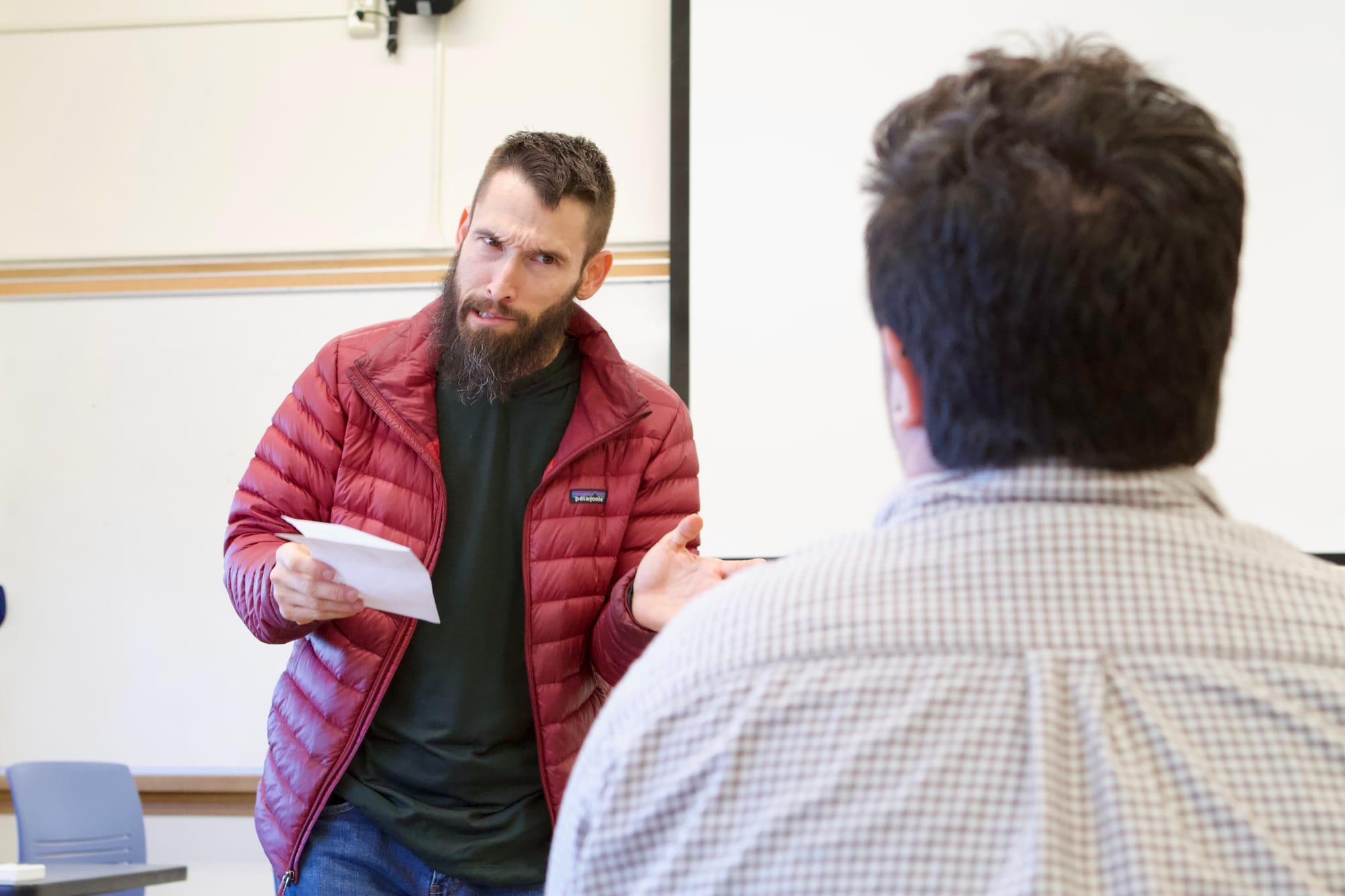
In one classroom, the students perform speeches. There is no podium, and the whiteboard serves as their stage — they move like actors and enunciate like poets.
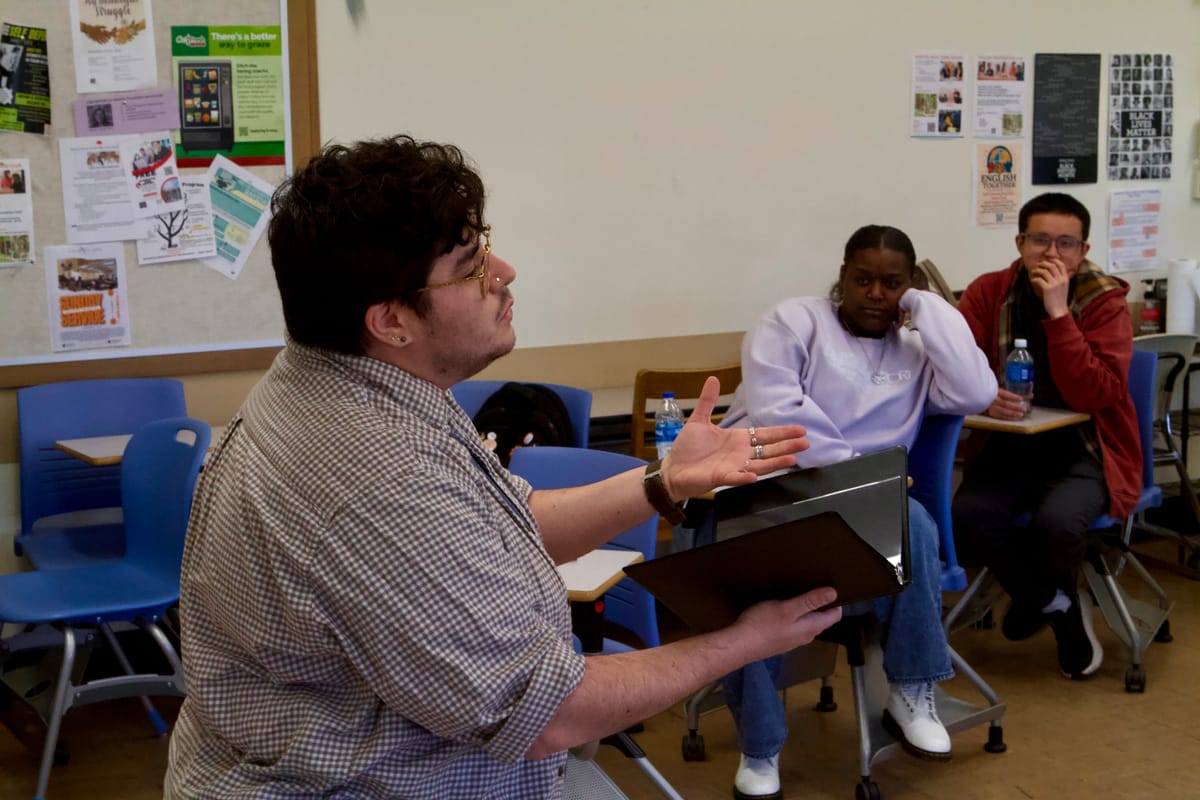
Garcia-Spiegel reads an excerpt from “On Venus, Have We Got a Rabbi!,” a 1974 science-fiction satire about Jewish aliens and humor as a community response to trauma.
Destiny Riley, in her second semester on the team, practices an oral interpretation — a 10-minute speech interweaving Emmett Till’s eulogy, “Stand Up” by Cynthia Erivo, and “Say Their Names” (a list of Black victims of police violence), among other sources.
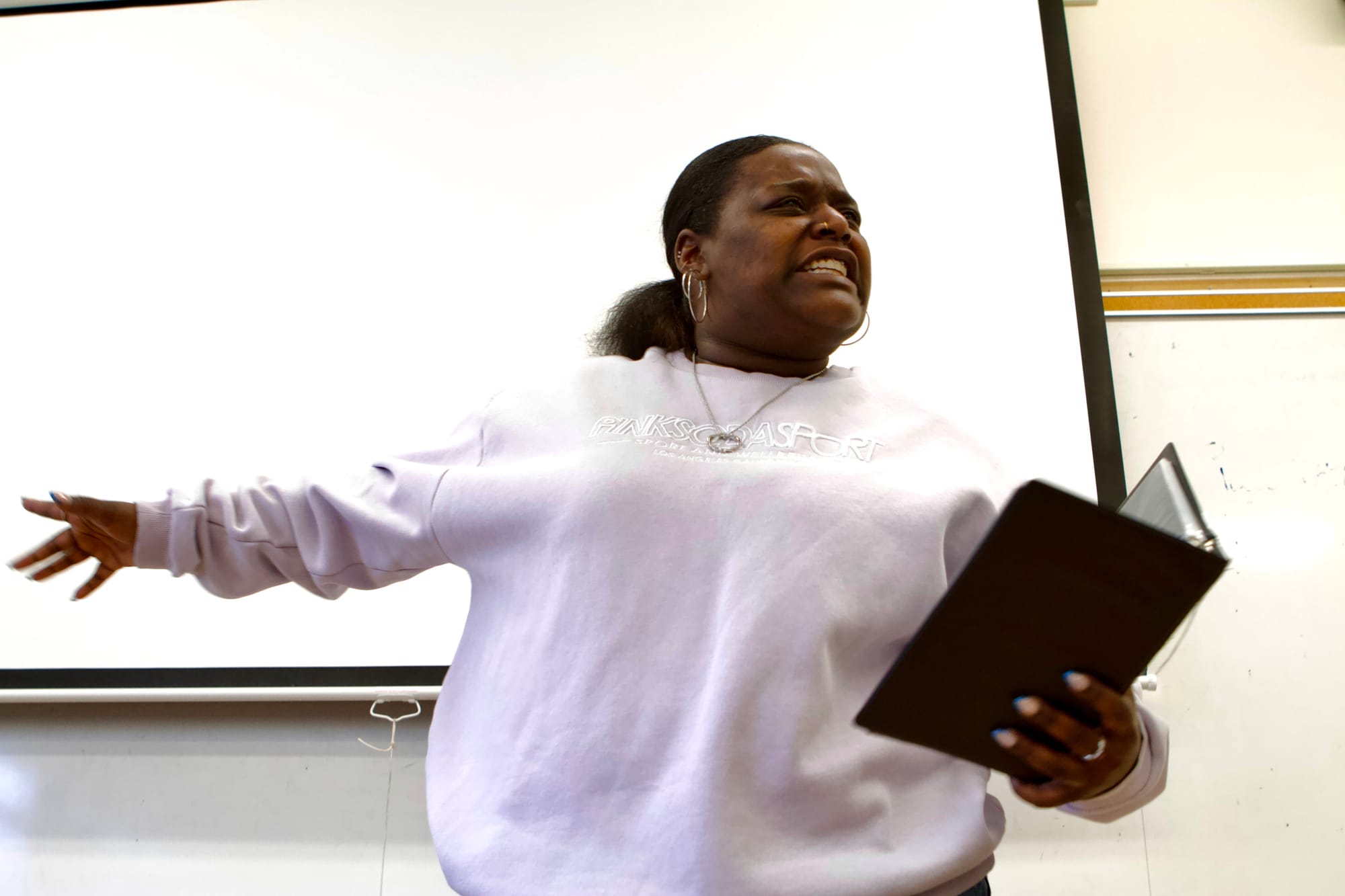
Litzky’s co-coach, Nathan Steele, looks on and gives feedback when necessary. Steele, who has coached the team since 2010, woke up at 5 a.m. that morning for a flight from New York to SFO, and took BART straight to City College to be at the team’s practice.
In the other room, Litzky and the students debate the question: “Is empathy a shared experience?”
No topic is off limits — one debater, Aiken A., invokes Gaza to back up his argument. After the mock debate is over, he apologizes to his interlocutor, Ayit Altintas, for using a potentially sensitive subject.
“I appreciate your gesture, it’s really meaningful,” Altintas says. “Now we understand each other much better because we had this shared experience.”
This is the magic Litzky referred to — not just the willingness to think and talk about everything, but to attend to each other’s emotions after the debate.
“That’s a profound moment,” Litzky said. “In a world where ‘who’s taking a debate class?’ In the semester where Charlie Kirk was murdered, there is such an inflamed political context. I feel so lucky to get to work with students that are showing up to think, to speak, to be empathetic, but also to have fun and perform the magic.”
Olivia Fife, the debate team lead and Garcia-Spiegel’s co-captain, is out with a health issue — the team all signed a card for her.
“I really feel that absence, because her energy is infectious,” Litzky said.
The students were preparing for the Bernacchi Invitational, a yearly tournament hosted at Diablo Valley College. The City College team travels to local and national events to compete against other two-year and four-year colleges, and hosts the Golden Gate Forensics Collective with San Francisco State, a twice-yearly tournament open to all communication studies majors.
Forensics is open to all students, and the class itself (CMST 38: Forensics Competition) fulfills a major requirement for anyone in Humanities.
Speech and debate provides opportunities beyond checking a box. According to Litzky, students often transfer to compete at other colleges and receive scholarships to do so. And when transferring to a large school, it helps to have an in with the campus speech and debate community.
The benefits extend to non-communication studies students. Litzky says the class often appeals to English language learners, nurses, and engineers.
Litzky knows the opportunities forensics can provide— she started competing in 2003 while an undergraduate at San Francisco State, and the calling soon became a career. She served as the Director of Forensics at SF State and restarted the Forensics team at USF before coming to City College.
“I’m one of these students that experienced the value (of speech and debate),” Litzky said. “It gave me a through-line to both finish my own collegiate career, and it inspired me to think about what I would do with my own voice and my own life.”
At least one of Litzky’s students is following in her footsteps. After securing a master’s in communication studies, Garcia-Spiegel hopes to return to City College as a teacher.
“I figured out pretty early on that I want to go into coaching,” Garcia-Spiegel said. “I want to be doing what Nathan and Alexis are doing for the rest of my life.”
Note: The Forensics Team’s season runs from the Fall to Spring semesters. To learn more, contact forensics@ccsf.edu.