Cast of ‘Earnest’ strives for authenticity
Unlike many contemporary adaptations of Shakespeare’s works that venture to modernize the production, City College’s theatre department is performing a historically accurate iteration of Oscar Wilde’s play “The Importance of Being Earnest.”
By Isaiah Kramer
The Guardsman
Unlike many contemporary adaptations of Shakespeare’s works that venture to modernize the production, City College’s theatre department is performing a historically accurate iteration of Oscar Wilde’s play “The Importance of Being Earnest.”
Premiering March 11, the two-hour play will run for two weeks with performances on Fridays, Saturdays and Sundays.
Actresses will lace up in gowns with bell-shaped skirts, while actors will be done up in frock coats, breeches and top hats. And they all will speak with a funny accent.
But don’t get the idea that the material in Wilde’s most acclaimed play is as outdated as the clothing. The satire has relevant motifs of classism, superficiality, sexual repression and possible homosexuality.
“One thing that is obvious to me is that this is a comedy,” Director John Wilk said. “And the actors aren’t under the same restrictions as in a drama.”
Circled in the foyer of the Diego Rivera Theatre before rehearsal, the cast recited their favorite lines from the play, provoking laughter.
The play’s themes become noteworthy in their hilarity, with the butt of most jokes directed at the characters themselves, who comprise a petty upper class.
“For the first couple weeks when we read through the script, we couldn’t stop laughing,” said Kelly Blong, who plays Algernon.
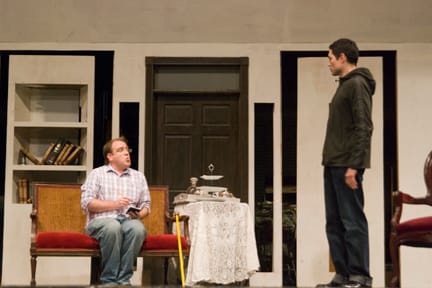
Upping the comedic factor and diverging from the original play, the part of the formidable Lady Bracknell will be done in drag. Jim Jones rehearsed the part wielding a diamond-knobbed cane in low-heeled black pumps and behaving like an overweight, snobbish matron.
The nine speaking actors and actresses spent four weeks mastering the dialect for the British play. The dialect itself is known as Received Pronunciation, which has roots in the upper class of southeastern England but is more recognizably the accent used in British broadcasting.
“Our one British actor on the cast had just as much trouble as the rest of us perfecting the accent,” said Carlos Halley, who plays Ernest Worthing.
The dialog in the play is quick-witted and fresh. The language is flowery, in part due to the accent, yet sharp. The dual-meanings, undertones and innuendos warrant close attention, as they are the minute details that give the play its greater aphoristic meaning.
“All the conversations have references to something. When they reference flowers or bunburying, it is thought to mean a man having sex with another man,” said Simon Warner Lane who plays the manservant.
In the opening scene there is talk of “bunburying down in the country.”
The sets are just as well conceived as the script. Wilk spent time creating the three sets before even casting the play. One set uses plants and trees from City College’s horticulture department.
The thrust stage places the performers amid the audience and garners a connection to the actors on stage.
Though the 116-year-old script and costumes are constants, the actors, obviously, are born in today’s world and their acting reflects it.
“We can’t help but put a contemporary spin on it with an American director and an American cast. We’re going to be more tactile, touch each other more than they did,” said Liota Tisdel-Rhodes, who plays leading lady Gwendolen.
Email:
ikramer@theguardsman.com