EBT Payments at Ocean Campus Cafeteria Still Months Away Despite Earlier Promise
Application submitted, but hurdles remain before students can use CalFresh benefits to buy meals on campus
By Patricia Baldwin
Two-thirds of California Community College students face food insecurity, according to the Foundation for California Community Colleges.
Vice Chancellor Lisa Cooper Wilkins said that she “consistently hears about food insecurity from [City College] students.”
One piece of state legislation designed to help students address food insecurity is AB 2033, which “requires that on or before Sept. 1, 2025, each campus of the California Community Colleges … if it has a general store or a store that sells food on campus, to identify and apply for at least one… store … to become an authorized retail food store under SNAP and, if approved, ensure the store or stores accept the use of EBT cards…”
Electronic Benefit Transfer cards allow users to spend their CalFresh benefits to purchase food.
In the Chancellor’s Report–January 2026, Vice Chancellor Wilkins wrote that “EBT cards [are] finally being accepted in the cafeteria as of March 1.”
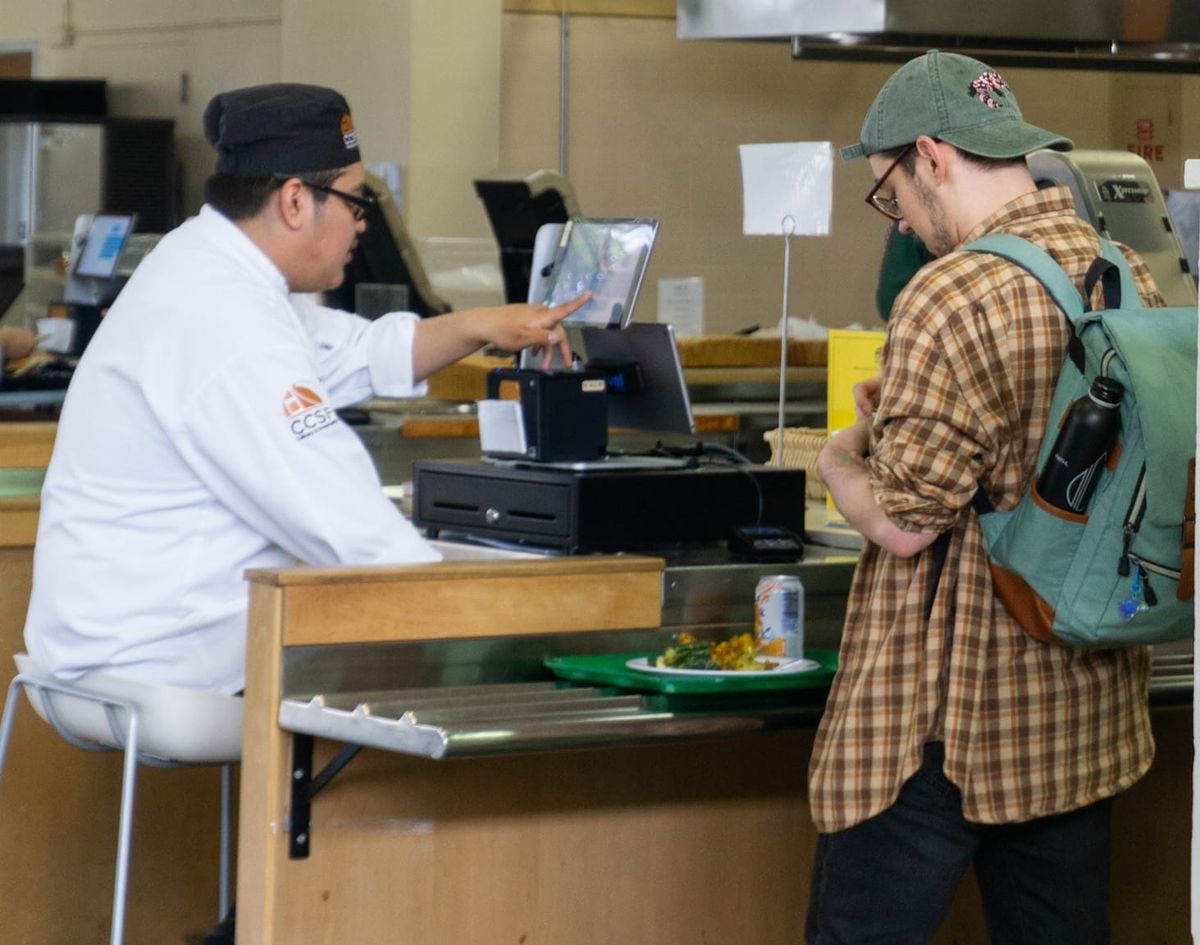
As The Guardsman reported last month, the cafeteria in Smith Hall on Ocean Campus did not begin accepting EBT payments in March. To pinpoint when City College students might have the option to use EBT to purchase food on campus, we spoke with Jennifer Rudd, chair of Culinary Arts and Hospitality Studies (Culinary), and Lisa Cooper Wilkins, Vice Chancellor of Student Affairs, in March.
Those interviews revealed the steps required to bring EBT to Ocean Campus: 1) Deciding on a location, 2) Identifying an EBT-compatible POS system, 3) Applying to be an authorized EBT retailer, 4) Setting up the physical system, 5) Training staff, and 6) Making the Ocean campus community aware of this new option.
The steps are discussed below with an assessment of the progress in each subheading.
1. Decide on a location – Completed
The cafeteria, The Lunch Box and the bookstore were discussed as options, according to Rudd and Wilkins.
“In contrast to the bookstore, which is run by Follett, a third party, the cafeteria is a permanent solution,” according to Rudd.
“It presents a unique situation with the Culinary department running the food service program,” Cooper said. Other locations, such as the Lunch Box, could also become authorized to accept EBT in the future, according to Wilkins.
2. Identify a POS system that accepts EBT – Completed
Revel, the Point-of-Sale (POS) system currently used by the cafeteria, does not accept EBT payments.
“Toast made sense for a lot of reasons. It accepts EBT payments, it works with the current food cards, which work on a gift card model, and because it is a common POS system in the restaurant industry, it provides an opportunity to train culinary students,” Rudd said.
3. EBT application/approval – Submitted
Any retailer that wants to be authorized to accept EBT must apply to the US Department of Agriculture’s Food and Nutrition Service (FNS). The online application is lengthy and requires the submission of multiple documents. City College plans to apply under the Restaurant Meal Program category, according to Rudd.
During the Executive Council meeting on April 17, Chancellor Messina said that the application had been submitted.
According to Rudd, government approval on the application can take up to 45 days. Rudd has heard that EBT applications can be denied with little feedback. If this were to happen, City College would then need to regroup and reapply.
4. Setting up the POS system – Not yet started
The physical components for the new POS network have been purchased. According to Rudd, they were awaiting installation.
Both acknowledged that there have already been some difficulties. Specifically, the current networking cabinet wasn’t designed to handle this new system. However, according to Rudd, IT can make it work.
Once the system is installed, it will be tested to ensure it works seamlessly with EBT and the current food cards, which function like gift cards. “We want to be mindful of the students we are already serving while working to expand access to more students,” Rudd said.
5. Staff training with new POS – Not yet started
This is probably the most straightforward step in the process. Once the POS is operational, culinary faculty and students will be trained in using it, according to Rudd.
6. Communication with campus community – Not yet started
Wilkins acknowledged that communication is an issue.
She indicated that a promotional plan would need to be worked out to ensure that students learned of this new option once it comes online. She said that “several points of entry, including Canvas, email, texts, and varied communication platforms would be utilized” to get the word out.
Target Date
Although both Rudd and Wilkins were hopeful that EBT payments could be accepted starting in the summer, Wilkins noted the project's slow timeline. Rudd acknowledged that fall was a more likely target.